Not finishing in time with 〜そうにない
Grammar Explanation: Looking like with 〜そうだ
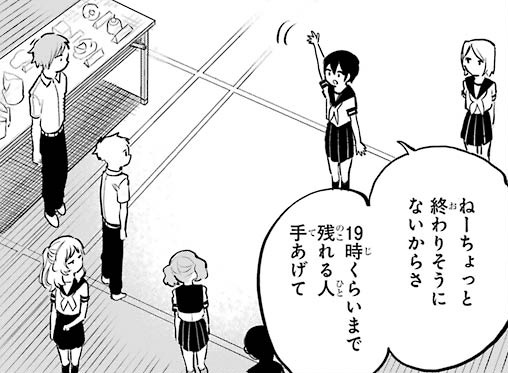
The culture festival is getting close, and the class is in the last stretch of its preparations. It’s almost six in the evening, and Asuka wants to get as much done as possible today. Mie can’t stay, though. Her curfew is six o’clock, and breaking it would mean a scolding and, worse, no cocoa the next morning. Komura figures her parents must be strict.
- あすか:
- 「ねーちょっと終わりそうにないからさ」
- “Hey, it doesn't look like we're going to finish, so…”
- 「19時くらいまで残れる人手あげて」
- “Raise your hand if you can stay until around seven.”
Key Points
- そうだ after a verb’s ます-stem predicts what looks likely to happen. 終わりそうだ would mean “it looks like we’ll finish”.
- そうにない negates the prediction: “it doesn’t look like we’ll finish”. It’s a stronger denial than 終わらなそう, and it hints that things aren’t going the way Asuka hoped.
- Asuka bases the judgment on what she sees, the work still left and the time, not on anything she heard.
- から gives the reason for her request: since they won’t finish, she needs volunteers.
- さ is a casual particle that softens the line and keeps the listener’s attention before she gets to the point.
- 残れる is the potential form of 残る, “to stay behind”. 残れる人 is “people who can stay”.
- 手あげて drops the particle を from 手をあげて. The て-form works as a casual request: “raise your hand”.
- くらい after 19時 gives a rough time, “around seven”.
Vocabulary
ちょっと (A little)
ちょっと describes a small amount or a short time. It also softens a refusal, or calls someone’s attention, like “hey”.
終わる (To end)
終わる is for something to come to an end. After a verb stem, it means to finish doing it.
そう (So)
そう means “like that” or “that way”. Said alone, it agrees: “right”. After a verb stem or adjective, it means something looks or seems a certain way.
残る (To remain)
残る is for something to be left over after the rest is gone.
人 (Person)
人 is a person, or people in general. It also means other people.
手 (Hand)
手 is a hand. It also means a way or means, or help from someone.
あげる (To give)
あげる is to give something to someone else. After a て-form verb, it means doing something for someone. It also means to raise something.
See Also
- Grammar: Looking like with 〜そうだ
- Grammar: Because with 〜から
- Grammar: Casual emphasis with さ
- Grammar: Able to do with 〜れる・〜られる
- Kanji: Hands and skill with 手
- Kanji: People and persons with 人