Not going camping with 〜ってば
Grammar Explanation: Insisting with 〜ってば
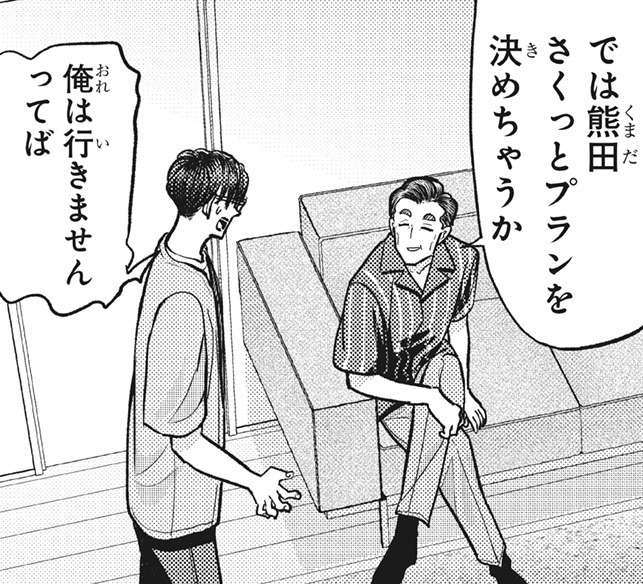
Kumada’s boss has shown up at his apartment uninvited to ask him on a company camping trip next week. Kumada refuses on the spot, listing the risks involved. His boss just answers that camping is fun.
- 上司:
- 「では熊田さくっとプランを決めちゃうか」
- “Well then, Kumada, let's hammer out the plan real quick.”
- 熊田:
- 「俺は行きませんってば」
- “I told you, I'm not going.”
Key Points
1Restating a refusal with ってば
- Kumada has said no more than once, and his boss is moving on to planning anyway. Adding ってば turns the refusal into “I told you”.
- ってば can follow a polite sentence. 行きません stays polite toward his boss, but the impatience comes through.
2俺は, “I’m the one not going”
- は sets 俺 apart as the topic. Whatever the others do, Kumada is staying home.
3さくっと決めちゃうか
- さくっと means doing something quickly and without fuss.
- 決めちゃう is the casual contraction of 決めてしまう, “go ahead and decide”. Ending with か turns it into a breezy “shall we?”, as if Kumada had already agreed.
Vocabulary
プラン (Plan)
プラン is a plan or scheme for doing something, such as a trip, an event, or a project. It also names a package or plan offered by a business, like a phone plan.
決める (To decide)
決める is to decide or settle something.
俺 (I)
俺 means “I” or “me”. Men commonly use it in casual speech, and it sounds rougher and more masculine than 私 or 僕.
行く (To go)
行く means to go or move toward a place away from the speaker.
See Also
- Grammar: Insisting with 〜ってば
- Grammar: Polite style with です and ます
- Grammar: Marking the topic with は and も
- Grammar: Doing completely or ending up doing with 〜てしまう and 〜ちゃう
- Kanji: Going and carrying out with 行
くまぐらし © its respective creators. It is used here for educational commentary.