Not hanging out as much as before with 〜ほど〜ない
Grammar Explanation: Not as much as with 〜ほど〜ない
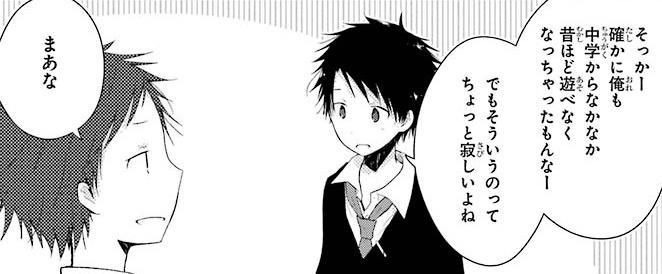
Kohei points out that this is the first time in a while he and Sana have talked this much. Ayumu asks why. Kohei says that between club activities, cram school, and entrance exams, everyone got busy, and they just got together less often.
- 歩:
- 「そっかー 確かに俺も中学からなかなか昔ほど遊べなくなっちゃったもんなー」
- “I see. Come to think of it, since middle school I haven't really been able to hang out as much as I used to, either.”
- 「でもそういうのってちょっと寂しいよね」
- “But that kind of thing is a little lonely, isn't it?”
- 康平:
- 「まあな」
- “I guess.”
Key Points
- Aほど〜ない means “not as … as A”. Here A is 昔, “the old days”, so 昔ほど遊べない means “can’t hang out as much as before”.
- The comparison is only partial. Ayumu still hangs out with friends, just less often than he used to.
- ほど needs a negative to make this comparison. Here the negative is the なく in 遊べなくなっちゃった.
- 遊べる is the potential form of 遊ぶ, “to hang out” or “to play”, so it means “can hang out”.
- 〜なくなる means “to stop” or “to no longer”. 遊べなくなる is “to become unable to hang out”.
- 〜ちゃった is the casual form of 〜てしまった. It presents the change as something that happened to him, with a touch of regret.
- With a negative, なかなか means “not easily” or “hardly”. It softens the statement and adds to the sense that hanging out became difficult.
- もん comes from もの and gives a reason. Ayumu offers his own experience to back up what Kohei said: “I’ve been through it too, after all.”
- The drawn-out なー makes it sound reflective, as if he’s talking partly to himself.
- 確かに means “certainly” or “true”. It shows Ayumu agrees with Kohei’s explanation.
- 俺も means “me too”. Ayumu says he went through the same thing Kohei describes.
Vocabulary
確かに (Certainly)
確かに agrees that something is true: “certainly” or “that’s true”.
俺 (I)
俺 means “I” or “me”. Men commonly use it in casual speech, and it sounds rougher and more masculine than 私 or 僕.
中学 (Middle school)
中学 is middle school, the three years of school after elementary school in Japan. It is a shortened form of 中学校.
なかなか (Quite)
なかなか means “quite” or “pretty”. With a negative, it means something does not happen easily.
昔 (Long ago)
昔 is the distant past, or one’s earlier days.
ほど (Extent)
ほど is the degree or extent of something: “about” or “as much as”. 〜ば〜ほど means “the more…, the more…”.
遊ぶ (To play)
遊ぶ is to play or have fun. 遊びに来る means to come over to visit.
なる (To become)
なる is to change into a different state or become something. It also means something turns out a certain way. It is also written 成る.
もん (Because)
もん ends a sentence to give a reason, often in a childish or pouting tone. It is a casual form of もの.
そういう (That kind of)
そういう describes something like the thing just mentioned.
ちょっと (A little)
ちょっと describes a small amount or a short time. It also softens a refusal, or calls someone’s attention, like “hey”.
寂しい (Lonely)
寂しい describes feeling lonely or missing someone, or a place that feels empty and desolate. It is also read さみしい.
まあ (Well)
まあ is a soft “well” that eases into what the speaker says, or accepts something half-heartedly. It also shows mild surprise, like “oh my”.
See Also
- Grammar: Coming to do with 〜ようになる
- Grammar: Doing completely or ending up doing with 〜てしまう and 〜ちゃう
- Grammar: Able to do with 〜れる・〜られる
- Grammar: Casual reasons with 〜もん
- Kanji: Learning and schooling with 学