Not just Machisu, but also Kyou with 〜だけでなく〜も
Grammar Explanation: Not only this but also that with 〜だけではなく〜も
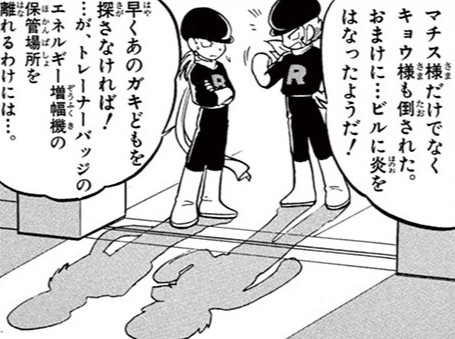
After infiltrating a Team Rocket hideout, Red, Green, and Blue take on the various Gym Leaders inside, including Machisu, Natsume, and Kyou. A couple of Team Rocket grunts discuss the fallout.
- したっぱ 1:
- 「マチス様だけでなくキョウ様も倒された。 おまけに…ビルに炎をはなったようだ!」
- “Not only Master Machisu, but Master Kyou was defeated too. On top of that... it looks like they set fire to the building!”
- Literal: “Not only Master Machisu, but Master Kyou too was defeated. On top of that... it seems they released flames into the building!”
- したっぱ 2:
- 「早くあのガキどもを探さなければ! …が、トレーナーバッジのエネルギー増幅器の保管場所を離れるわけには…。」
- “We have to find those brats quickly! ...But we cannot leave the place where the Trainer Badge energy amplifier is being stored...”
- Literal: “We must quickly find those brats! ...But we cannot leave the storage place of the Trainer Badge energy amplifier...”
Key Points
1だけでなく〜も adds Kyou to the bad news
- マチス様だけでなくキョウ様も means “not only Master Machisu, but Master Kyou too”.
- The noun before だけでなく is the first affected person; the noun before も is the additional person included in the same outcome.
2倒された is receptive past of 倒す
- Both マチス様 and キョウ様 are linked to 倒された, so both of them were defeated.
- 倒す is a verb ending in す, so its receptive form is 倒される, and the past form is 倒された.
- The receptive keeps the focus on what happened to their leaders, not on who defeated them.
3様 shows Team Rocket’s deference
- 様 after each name makes the grunts sound respectful toward the Gym Leaders.
4探さなければ means they have to search
- 探さなければ is the shortened form of 探さなければならない, “must search”.
- The full pattern is negative verb + なければならない: literally, “if we do not search, it will not do.”
- In urgent speech, the final ならない or いけない is often left unsaid once the obligation is clear.
5わけにはいかない means circumstances will not allow it
- 離れるわけには… trails off from 離れるわけにはいかない, “cannot leave”.
- Here わけ points to the situation or reason that would make leaving unacceptable: they are guarding the storage place.
- Do not read this as simply “there is no reason to leave”; the phrase says they may want to leave, but duty makes it impossible.
Vocabulary
あの (That)
あの comes before a noun to mean “that” or “those”. It points to someone or something away from both speakers, or something they both know about.
バッジ (Badge)
バッジ is a badge worn or carried to show membership, rank, or identity.
保管場所 (Storage location)
保管場所 means a storage location or place where something is kept for safekeeping.
See Also
- Grammar: Not only this but also that with 〜だけではなく〜も
- Future entry: Past tense with 〜た・〜だ
- Grammar: Must do with 〜なければならない
- Grammar: The copula だ
- Grammar: Marking the topic with は and も
ポケットモンスタースペシャル © its respective creators. It is used here for educational commentary.