Not knowing what a low flame means with とろ火
Vocabulary Explanation: Collocations for cooking
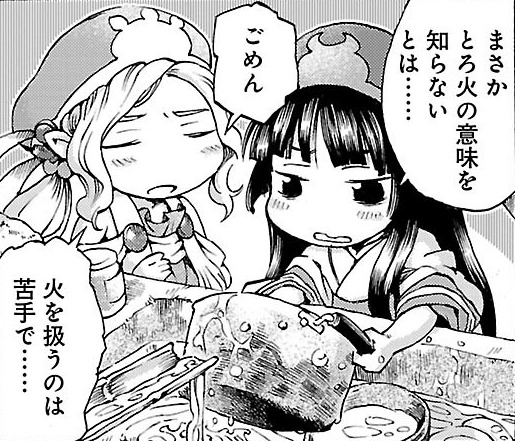
Konju is helping Mikochi make honey waffles, and Mikochi told her to warm the bowl of eggs and honey in a pot of water kept at a simmer. While Mikochi was lost in thought about the recipe, the flame roared up and the eggs and honey cooked into a solid lump. Konju insisted she’d kept it at a simmer, and Mikochi had her turn the heat off.
- ミコチ:
- 「まさかとろ火の意味を知らないとは……」
- “I never dreamed you wouldn't know what simmer means…”
- Literal: “That (you) don't know the meaning of simmer, of all things…”
- コンジュ:
- 「ごめん」
- “Sorry.”
- 「火を扱うのは苦手で……」
- “I'm no good with fire…”
- Literal: “Handling fire is something I'm bad at, so…”
Key Points
- とろ火 is a very low, gentle flame, lower than 弱火. とろ comes from とろとろ, which describes something burning or simmering weakly.
- Recipes name heat levels with 強火, 中火, 弱火, and とろ火. 火 reads び inside these compounds.
- A double boiler needs gentle heat so the eggs warm without setting. Konju’s flame was strong enough to cook them solid.
- まさか marks something the speaker would have thought impossible.
- とは after a plain-form clause shows surprise or disbelief at that fact. The rest of the thought, such as 思わなかった (“I didn’t think”), is left unsaid.
- Together they make a common exclamation: まさか負けるとは, “I never thought we’d lose.”
- のは turns 火を扱う, “handle fire”, into a noun phrase, so it can be the topic: “handling fire is ~”.
- 苦手 means bad at or uncomfortable with something. It’s the opposite of 得意.
- で is the て-form of だ. Here it gives a reason, and Konju trails off before finishing the apology.
Vocabulary
まさか (Surely not)
まさか marks something as hard to believe or unexpected, like “no way” or “surely not”. With a clause ending in とは, it means “I never thought that…”.
とろ火 (Low flame)
とろ火 is a very low flame on a stove, used to simmer or warm food slowly.
意味 (Meaning)
意味 is the meaning or point of a word, statement, action, or event.
知る (To know)
知る means to learn or come to know a fact or person. In the form 知っている, it describes already knowing.
火 (Fire)
火 is fire or flame. In cooking, it also means the heat of a stove, as in 火を通す, “to cook something through”.
扱う (To treat)
扱う is to handle or deal with something. 〜扱いする means to treat someone as something, such as a suspect.
苦手 (Weak point)
苦手 means something one is bad at or someone one finds difficult to deal with.
See Also
- Vocabulary: Collocations for cooking
- Grammar: Connecting actions with 〜て・〜で
- Grammar: Marking the topic with は and も
- Grammar: Negation with 〜ない
- Kanji: Hands and skill with 手
- Kanji: Taste and meaning with 味
- Kanji: Thought and intention with 意