Not letting anyone find out with 〜ないようにしろ
Grammar Explanation: Making an effort to with 〜ようにする
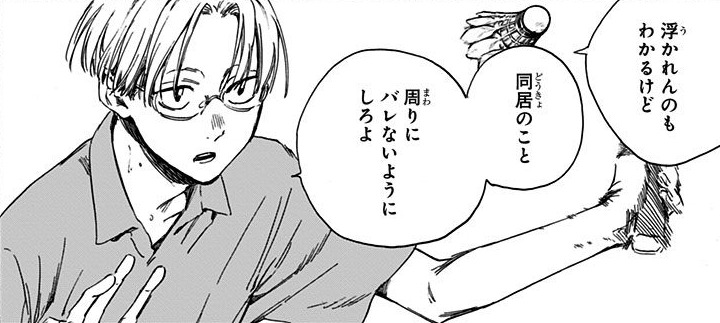
Chinatsu has moved into Taiki’s family’s house. At badminton practice the next day, he’s in high spirits. His friend Kyo is aware of the living arrangement.
- 匡:
- 「浮かれんのもわかるけど」
- 「同居のこと周りにバレないようにしろよ」
- “I get why you're walking on air, but...”
- “...make sure nobody around here finds out you two live together.”
Key Points
- 〜ないようにする means taking care that something does not happen. しろ is the plain imperative of する, so 〜ないようにしろ tells the listener to make sure of it. It’s blunt, but between friends it reads as a warning, not a harsh order.
- Kyo isn’t asking Taiki to do one specific thing. He wants him to keep watch over an outcome. Nobody should learn about the living arrangement, however that has to be managed.
- バレる means a secret comes out. 周りに marks who it would come out to: the people around them at school.
- The sentence-final よ presses the warning on Taiki.
- 同居 means living under the same roof. Adding のこと makes it “the matter of living together”, the thing that has to stay secret.
- It is the subject of バレない. In full it would be 同居のことが周りにバレないように, but casual speech often drops the particle.
- 浮かれる means being giddy or carried away with happiness. 浮かれんの is 浮かれるの. In casual speech, る often becomes ん before の.
- の turns the verb into a noun, “being giddy”, and も adds “that too”. Kyo can see why Taiki is excited. けど then sets up the warning that follows.
Vocabulary
浮かれる (To be giddy)
浮かれる is to be in high spirits and a little carried away, often over good news or a festive mood.
わかる (To understand)
わかる is to understand something, or for something to become known or clear. It is also written 分かる.
こと (Thing)
こと is an abstract thing, matter, or fact, as opposed to a physical object. It also turns a verb phrase into a noun, as in 見たことがある. It is also written 事.
周り (Surroundings)
周り is the area around someone or something, or the people around them.
バレる (To be found out)
バレる is for a secret or a lie to come to light.
よう (Way)
よう follows a word to show a way or manner, or that something seems a certain way. ようになる means to reach a point where something happens. It is also written 様.
する (To do)
する is to do or perform something. It also turns many nouns into verbs, as in 勉強する.
See Also
- Grammar: Making an effort to with 〜ようにする
- Grammar: The plain imperative
- Grammar: How casual contractions work