Not moving while staring with 〜ながら
Grammar Explanation: Concurrent events with 〜ながら
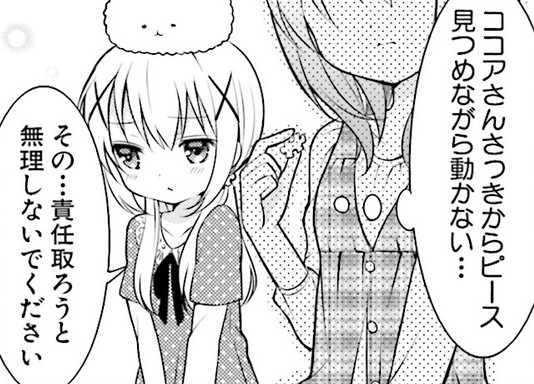
Cocoa buys Chino a puzzle to make up for finishing the one Chino had been working on. The two and their friends work at putting the new puzzle together.
- チノ:
- 「ココアさんさっきからピース見つめながら動かない…」
- “Cocoa-san has been staring at the puzzle piece while not moving for a while now...”
- Literal: “Cocoa has been staring at the piece while not moving since earlier...”
- 「その…責任取ろうと無理しないでください」
- “Um... Please don't push yourself trying to take responsibility.”
Key Points
- Cocoa keeps staring at the piece while remaining motionless. Cocoa is the subject of both actions.
- 見つめる changes to its stem 見つめ before ながら, while 動かない carries the main observation.
- さっきから explains that Chino has watched this state persist for some time.
- The volitional 取ろう plus と frames taking responsibility as what Cocoa is trying to do.
- 〜ないでください asks Cocoa not to push herself, rather than describing an action she does not take.
- さん is an honorific suffix attached to a person’s name to show respect and social distance, roughly equivalent to “Mr.”, “Ms.”, or “Mrs.” in English, though it’s used far more broadly and doesn’t specify gender or marital status.
Vocabulary
| Word | English | Meaning |
|---|---|---|
| ピース | Piece | ピース is a piece, such as a jigsaw puzzle piece. It can also mean the peace sign. |
| 見つめる | To stare at | 見つめる is to look at something steadily for a long time. |
| 動く | To move | 動く is to move, or for something to change position. It also means for a machine to work. |
| その | That | その points to something near the listener or to something just mentioned. Said alone, it fills a pause, like “um”. |
| 責任 | Responsibility | 責任 is a duty one must carry out, or the blame one must accept when something goes wrong. |
| 取る | To take | 取る means to take or obtain something. Its exact sense depends on what is being taken. |
| 無理 | Impossible | 無理 means impossible, unreasonable, or too demanding. In conversation, it can mean “that’s impossible” or warn someone not to push too hard. |
See Also
- Grammar: Concurrent events with 〜ながら
- Grammar: Volitional with 〜う・〜よう
- Grammar: Connecting actions with 〜て・〜で
- Grammar: Polite style with です and ます
- Grammar: Receiving kindness with 〜てくれる
- Grammar: Negation with 〜ない
- Grammar: Without doing and please don't with 〜ないで
- Kanji: Absence and nothingness with 無
- Kanji: Motion and activation with 動
- Kanji: Seeing and viewpoints with 見