Not sacrificing time with friends with 犠牲
Kanji Explanation: Sacrifice and offerings with 犠
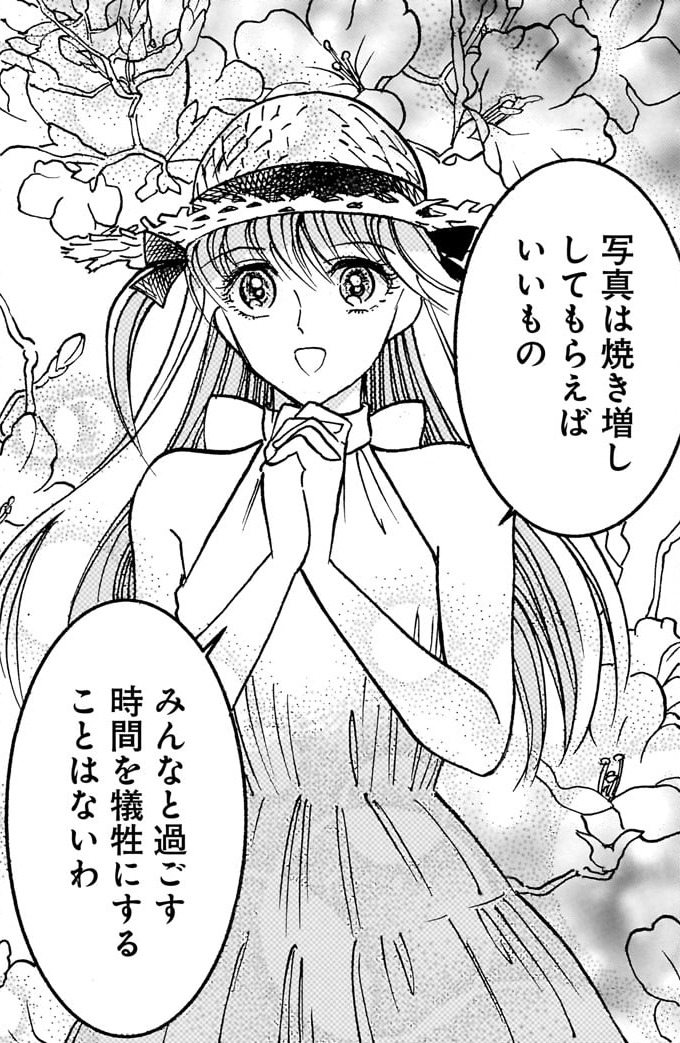
Lulu has come back during summer vacation to visit friends from the school she used to attend. She brought along a photo from her new school’s camping trip, the only one she has from there. A gust of wind blew her hat off, and in the commotion the photo flew away. Her friends offer to split up and search for it.
- ルル:
- 「写真は焼き増ししてもらえばいいもの」
- “I can just get the photo reprinted, after all.”
- 「みんなと過ごす時間を犠牲にすることはないわ」
- “There's no need to sacrifice the time I get to spend with all of you.”
Key Points
- 犠牲 is a sacrifice. With にする, it means to give something up for the sake of something else: Xを犠牲にする.
- Here the thing Lulu would give up is みんなと過ごす時間, the time she spends with her friends. The thing gained would be the photo.
- The word doesn’t need a life or a disaster. People sacrifice sleep, weekends, or hobbies with the same phrase.
- Dictionary form + ことはない says an action is unnecessary. 犠牲にすることはない means “there’s no need to sacrifice it.”
- It often reassures the listener, as Lulu does here when she turns down her friends’ offer to help.
- 焼き増し is an extra print made from a photo’s negative or file. 焼き増しする means to have more prints made.
- 〜てもらう shows that someone else does it for her, such as a photo shop or whoever has the original. 〜ばいい means “I can just” or “all I have to do is.”
- Sentence-final もの gives a reason in a gentle, somewhat feminine way, like “after all.” Lulu explains why the photo isn’t worth chasing.
- Sentence-final わ softens her second line. Both fit Lulu’s polite, well-mannered speech.
- The clause みんなと過ごす comes before 時間 and describes it: “the time I spend with everyone.”
Vocabulary
| Word | English | Meaning |
|---|---|---|
| 写真 | Photograph | 写真 is a picture taken with a camera. |
| 焼き増し | Photo reprint | 焼き増し is an extra print of a photograph made from the original. 焼き増しする means to have more copies printed. |
| する | To do | する is to do or perform something. It also turns many nouns into verbs, as in 勉強する. |
| もらう | To receive | もらう is to receive something from someone. After a て-form verb, it means to have someone do something for you. It is also written 貰う. |
| いい | Good | いい describes something good, nice, or fine. It can also mean “okay” or “that’s enough”. Its other forms come from よい, as in よくない and よかった. |
| みんな | Everyone | みんな means all the people in a group, or everything. It is also written 皆. |
| 過ごす | To spend time | 過ごす is to spend time or live through a period in a certain way. |
| 時間 | Time | 時間 is time, or an amount of time. It also means an hour, or a set time for something. |
| こと | Thing | こと is an abstract thing, matter, or fact, as opposed to a physical object. It also turns a verb phrase into a noun, as in 見たことがある. It is also written 事. |
| ない | Not | ない means something does not exist or someone does not have it. After a verb, it makes the verb negative. It is also written 無い. |
See Also
- Kanji: Sacrifice and offerings with 犠
- Grammar: Hypothetical condition with 〜ば
- Grammar: Having someone do something with 〜てもらう
- Grammar: Casual reasons with 〜もん
- Kanji: Spaces and intervals with 間
- Kanji: Time and occasions with 時