Not used to calling friends by name with 〜のこと名前で呼ぶ
Grammar Explanation: Referring to a person with 〜のこと
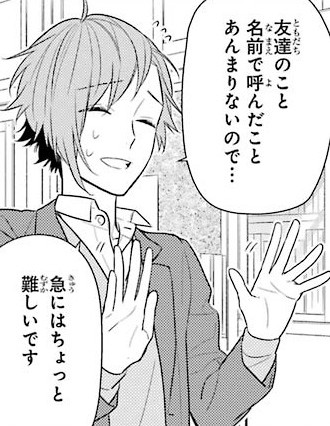
Yanagi speaks politely to everyone in the group, though he talks casually with Yuki. Iura tells him to call everyone by their first names and announces that he’ll call Yanagi “Akane” from now on. Then he asks Yanagi to call him by his first name too.
- 柳:
- 「友達のこと名前で呼んだことあんまりないので…」
- “I've hardly ever called my friends by their names, so...”
- 「急にはちょっと難しいです」
- “It's a little hard to do all of a sudden.”
Key Points
- Xのこと(を)Yで呼ぶ means “call X by Y”. で marks the way you address someone, and 名前 here means a first name.
- Iura has just asked the same thing with 俺のこと名前で呼んで, “call me by my name”. Yanagi answers with the same pattern.
- 〜たことがない means “have never done”. あんまり with a negative softens it to “hardly ever”. The が has dropped.
- ので gives this as his reason, and trailing off leaves “so I can’t” unsaid.
- は after 急に narrows the problem to the suddenness: doing it right away is hard, though it might not be later.
- ちょっと softens the refusal, and です keeps it polite. Iura answers by banning keigo on the spot.
Vocabulary
友達 (Friend)
友達 means a friend or companion. Despite the suffix 達, it can refer to either one friend or several friends.
こと (Thing)
こと is an abstract thing, matter, or fact, as opposed to a physical object. It also turns a verb phrase into a noun, as in 見たことがある. It is also written 事.
名前 (Name)
名前 means a name, the word used to identify a person or thing.
呼ぶ (To call)
呼ぶ is to call out to someone, call someone over, or call something by a name.
あんまり (Not very)
あんまり is a casual form of あまり. With a negative, it means “not very” or “not much”. On its own, it means “too much”.
ある (To exist)
ある is to exist or be in a place, for things and plants rather than people or animals. It also means to have something, or for an event to take place.
急に (Suddenly)
急に means suddenly or without warning. 急には often comes before something that’s hard to do on such short notice.
ちょっと (A little)
ちょっと describes a small amount or a short time. It also softens a refusal, or calls someone’s attention, like “hey”.
難しい (Difficult)
難しい describes something hard to do or understand.
See Also
- Grammar: Referring to a person with 〜のこと
- Grammar: Previous experience with 〜た+ことがある
- Kanji: Reaching and attaining with 達