Not without longing for a pet with 〜ないわけじゃない
Grammar Explanation: Not necessarily with 〜わけではない
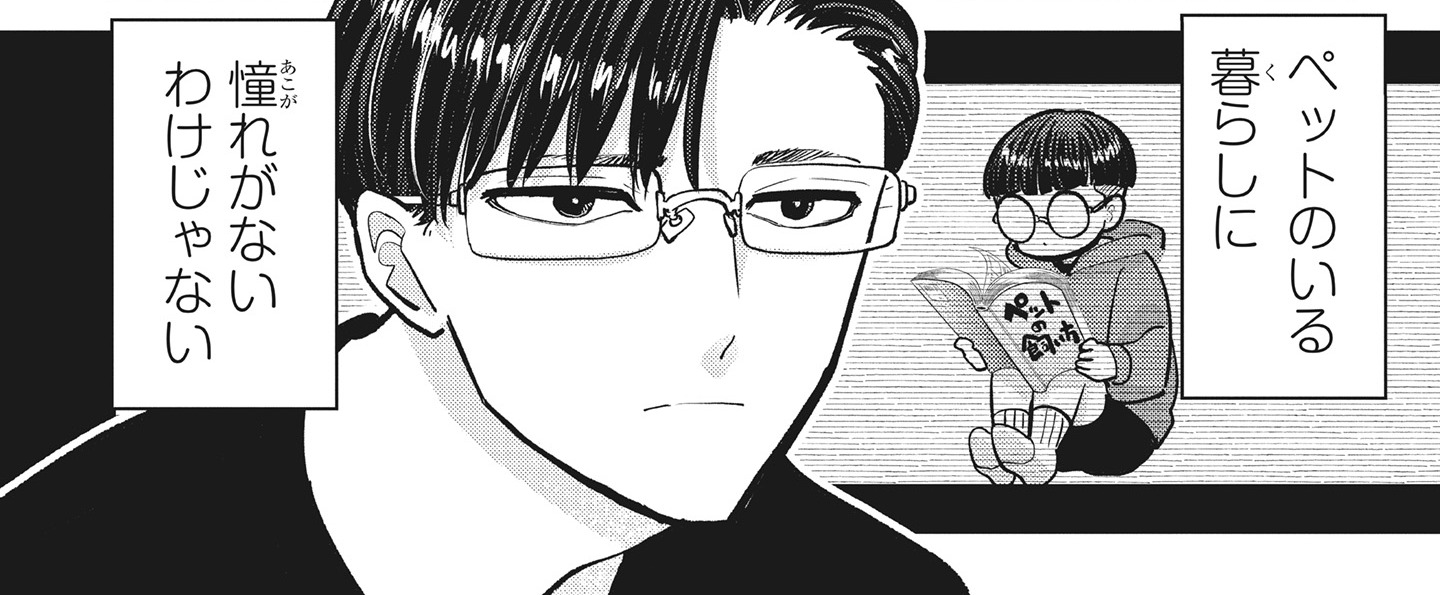
Kumada wishes the bear that lives with him were as cute as the neighborhood cat that visits. Later, he watches a TV segment in which a woman gushes about her dog. It’s part of the family, it sleeps with her at night, and life with a pet is the best.
- (熊田):
- 「ペットのいる暮らしに憧れがないわけじゃない」
- “It's not that I've never longed for a life with a pet.”
- Literal: “It isn't the case that there's no longing toward a life where there's a pet.”
Key Points
- わけじゃない is the casual form of わけではない. It rejects a conclusion someone might draw.
- The word before it is already negative: 憧れがない, “there’s no longing”. Rejecting that makes a double negative, which comes out as a qualified yes.
- Kumada could have said 憧れがある, “I long for it”. The double negative sounds more reluctant, as if he’s admitting something he’d rather keep quiet.
- 憧れ is the noun form of 憧れる, “to long for” or “to admire”. It names a yearning for something out of reach.
- に marks what the longing is aimed at: ペットのいる暮らしに憧れ(がある), “a longing for a life with a pet”.
- ペットのいる modifies 暮らし. Inside a modifying clause, の can replace the subject marker が: ペットがいる → ペットのいる.
- いる is used because a pet is a living thing.
Vocabulary
ペット (Pet)
ペット is a pet, an animal kept at home for companionship, such as a dog or a cat.
いる (To be)
いる is to exist or be somewhere, for people and animals. After a て-form verb, it shows an ongoing action or a continuing state.
暮らし (Life, living)
暮らし is the way someone lives day to day, from their home life to how they get by. It is the noun form of 暮らす, “to live”.
憧れ (Longing)
憧れ is a longing for something out of reach, or admiration for someone you look up to. It is the noun form of 憧れる.
ない (Not)
ない means something does not exist or someone does not have it. After a verb, it makes the verb negative. It is also written 無い.
わけ (Reason)
わけ is a reason or meaning. It also appears in grammar patterns such as わけがない, “there’s no way”, and わけにはいかない, “can’t very well”.
See Also
- Grammar: Not necessarily with 〜わけではない
- Grammar: Marking the subject with が
- Grammar: Negation with 〜ない