Nothing for a thief to take with 盗られる
Vocabulary Explanation: Taking, catching, and photographing with とる
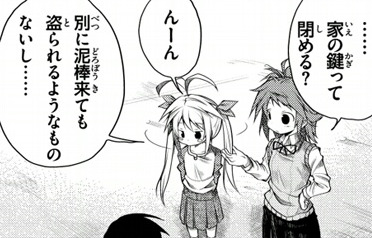
Hotaru moved from a school in Tokyo to the village’s tiny school this year. In the middle of a game of dodgeball, Renge finds a key on the ground, and Hotaru says it’s hers. Nobody will be home until night, so she brought her house key with her. Natsumi stares at her, puzzled, and then turns to Renge.
- 夏海:
- 「……家の鍵って閉める?」
- “...Do you lock your house?”
- れんげ:
- 「んーん」
- “Nuh-uh.”
- 「別に泥棒来ても盗られるようなものないし……」
- “Even if a burglar came, there's nothing worth stealing...”
Key Points
- 盗る is the verb とる written with the 盗 of 盗む, “steal”, and 強盗, “robbery”. The kanji tells the reader the taking is theft.
- The default spelling 取る could also write this line, and it would still mean “get taken”. With a burglar in the same sentence, the author picked 盗 to make the theft plain.
- The 常用漢字表 lists no とる reading for 盗. Manga use it anyway, mostly in the receptive 盗られる.
- 盗られる is the receptive of 盗る: “get stolen”. The thing taken is the subject, so 盗られるようなもの is “the kind of thing that would get stolen”.
- Renge doesn’t say the burglar takes the stuff with に. The burglar is already in the first half of the sentence, so the receptive clause doesn’t repeat it.
- 〜ても grants a condition and says the outcome stays the same. 泥棒来ても is “even if a burglar came”, with the が after 泥棒 dropped.
- 別に sets up a shrug: “it’s not like it matters”. Together with ても, Renge is saying a burglar is no worry at all.
- ようなもの after a verb is “the kind of thing that”. ものない is ものがない with the particle dropped: “there’s nothing like that”.
- し at the end gives a reason and leaves it hanging. That’s why she doesn’t lock her house, and she lets the rest go unsaid.
- って marks the topic in casual speech, like は. 鍵を閉める is “lock the door”, literally “close the lock”.
- んーん is a casual “no”, said here while shaking her head.
Vocabulary
| Word | English | Meaning |
|---|---|---|
| 家 | House | 家 is a building where people live. |
| 鍵 | Key | 鍵 is a key, and in everyday speech also the lock it opens. It is the deciding factor in a matter too, as in 鍵を握る. Read けん, it is a key of a piano or keyboard. |
| 閉める | To close; to lock | 閉める is to close a door, window, lid, or shop. 鍵を閉める is “lock up”, and 店を閉める is “close the shop” for the day or for good. |
| 別に | Not particularly | 別に means “not particularly” when used with a negative. Said alone, it means “nothing in particular” or “it doesn’t matter”. |
| 泥棒 | Thief | 泥棒 is a person who steals, and also the act of stealing. It is the everyday word, where news reports say 窃盗. |
| 来る | To come | 来る means to come or move toward the speaker or the place being discussed. |
| 盗る | To steal | 盗る is to steal something, to take what belongs to someone else. It is a spelling of とる that stresses theft. |
| ような | Like | ような follows a word to compare something to it: “like” or “such as”. At the end of a sentence, it shows the speaker’s impression. |
| もの | Thing | もの is a physical thing or object. It also appears in many grammar patterns. It is also written 物. |
| ない | Not | ない means something does not exist or someone does not have it. After a verb, it makes the verb negative. It is also written 無い. |
See Also
- Vocabulary: Taking, catching, and photographing with とる
- Grammar: Receptive verbs with 〜れる
- Grammar: Even if with 〜ても
- Kanji: Homes and specialists with 家