Oden fixings fresh from the fryer with 揚げたて
Vocabulary Explanation: Collocations for cooking
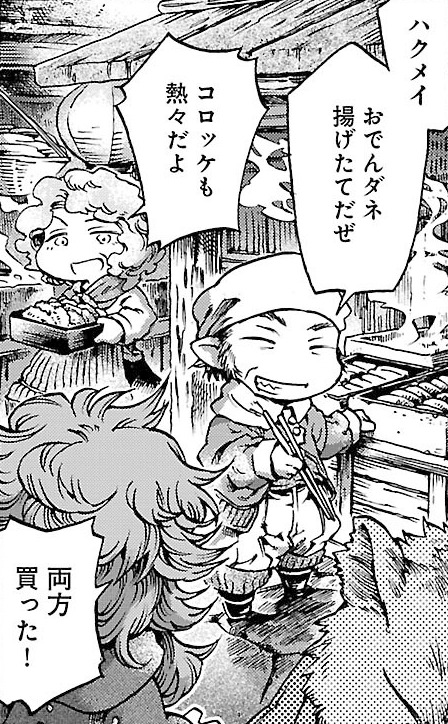
Hakumei and Mikochi are showing Iwashi around the city and want to find a restaurant he’d like for dinner. Nothing works out. One place is too cramped for him, another is closed, and he wants nothing sweet for dinner. They give up and head into a busy street of food stalls.
- 店主Ⓐ:
- 「ハクメイ おでんダネ揚げたてだぜ」
- “Hakumei! The oden fixings are fresh out of the fryer!”
- 店主Ⓑ:
- 「コロッケも熱々だよ」
- “The croquettes are piping hot, too!”
- ハクメイ:
- 「両方買った!」
- “I'll take both!”
Key Points
- 揚げる means to deep-fry. Add たて to a verb’s stem and it means the action has only just finished: 揚げたて, freshly fried.
- The same pattern names other fresh food: 焼きたてのパン (bread hot from the oven), 炊きたてのご飯 (rice just cooked), 出来たて (just made).
- Vendors call it out because fried food is best in the first few minutes, while it’s still crisp.
- タネ (種) means the ingredients that go into a dish. Joined to おでん, its た becomes だ: おでんダネ. The same sound change gives すしダネ for the fish on sushi.
- Many oden ingredients are fried fish cakes, such as さつま揚げ. This stall fries them on the spot.
- The man ends with だぜ, a rough, friendly way to state a fact. The woman ends with だよ, which also tells the listener something new but sounds softer.
- 熱々 doubles 熱い to mean piping hot. も adds the croquettes to the oden fixings: the croquettes are hot, too.
- Hakumei answers with 両方買った!, “I’ll take both!” The past tense 買った announces that she has made up her mind.
Vocabulary
おでん (Oden)
おでん is a winter dish of ingredients such as daikon, boiled eggs, konnyaku, and fish cakes, simmered for a long time in a light soy-flavored broth.
タネ (Ingredients)
タネ, also written 種, means a seed. In cooking, it means the ingredients that go into a dish, as in すしダネ for the fish on sushi and おでんダネ for the items in oden. It also means a trick’s secret, as in 手品のタネ.
揚げる (To deep-fry)
揚げる means to deep-fry food in hot oil. It also means to send something up into the air, such as a flag or a kite.
たて (Freshly)
コロッケ (Croquette)
コロッケ is a croquette, a deep-fried patty of mashed potato or meat coated in breadcrumbs.
熱々 (Piping hot)
熱々 describes food or drink that is piping hot, fresh off the heat. It also describes a couple who are madly in love.
両方 (Both)
両方 is both of two things or two sides together. Its opposite is 片方, one of the pair.
買う (To buy)
買う is to buy something.
See Also
- Vocabulary: Collocations for cooking
- Grammar: Rough declarations with ぞ and ぜ
- Grammar: Informing with よ
- Grammar: Compound voicing with 連濁