Oiling the takoyaki plate with 油をひく
Vocabulary Explanation: Collocations for cooking
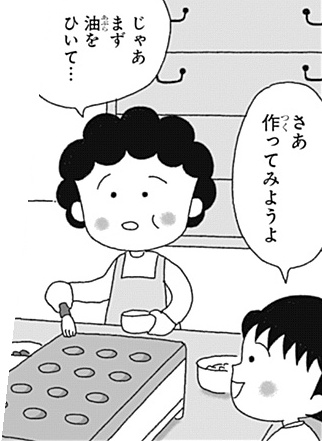
Maruko begged for a takoyaki maker, and Mom said no. Grandpa bought her one anyway, and Maruko talked him into the pricier model with its own burner so they could cook at the table. Mom grumbled, but the two of them pressed her to start making takoyaki right away.
- まる子:
- 「さあ作ってみようよ」
- “Come on, let's try making some!”
- お母さん:
- 「じゃあまず油をひいて…」
- “All right, first you oil the plate…”
Key Points
- ひく here means to spread something thinly over a surface. Cooks ひく oil on a frying pan, a griddle, or a takoyaki plate before cooking so nothing sticks.
- The kanji is 引く, the same verb as “to pull”, but recipes almost always write it in kana, as Mom’s line does.
- Compare 油で揚げる, deep-frying in a lot of oil, and 油で炒める, stir-frying in a little. With ひく, the oil is the thing being spread, so it takes を.
- じゃあ takes up Maruko’s push to get started, and まず marks the first step in a sequence.
- Mom stops on the て-form. It’s how people talk while walking through steps: “first you do this, and then…”. The next step would follow after the て.
- 〜てみる means to do something to see how it goes. This is their first time using the new griddle.
- みよう is the volitional form of みる, “let’s”. よ after it presses the suggestion on Mom.
Vocabulary
作る (To make)
作る means to create or prepare something.
みる (To see)
みる is the kana spelling of 見る, “to see”. After a て-form verb, it means to try doing something to see how it goes.
まず (First)
まず means first, before anything else, and often opens a list of steps. It is also written 先ず.
油 (Oil)
油 is oil, such as cooking oil or fuel oil. In talk about food, it also covers the fat or grease in a dish.
ひく (To pull; to spread thinly)
ひく, usually written 引く, means to pull. In cooking, it means to spread a thin layer of oil over a pan or griddle, as in 油をひく.
See Also
- Vocabulary: Collocations for cooking
- Grammar: Trying it out with 〜てみる
- Grammar: Volitional with 〜う・〜よう
- Grammar: Connecting actions with 〜て・〜で
- Grammar: Marking the direct object with を
- Kanji: Making and creating things with 作