Once upon a time a king and queen with 王妃
Kanji Explanation: Royal consorts with 妃
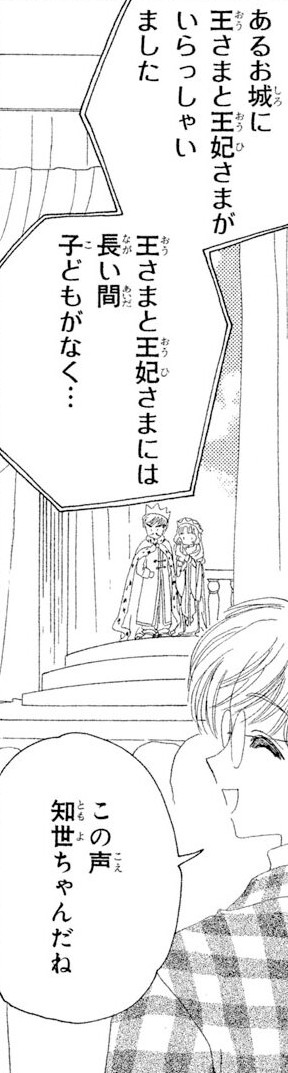
Sakura’s class is staging Sleeping Beauty for the school play, and Syaoran has reluctantly agreed to play the princess. With Yukito and Touya in the audience, the buzzer sounds and the curtain rises.
- 知世:
- 「あるお城に王さまと王妃さまがいらっしゃいました」
- “Once upon a time, in a certain castle, there lived a king and queen.”
- 「王さまと王妃さまには長い間子どもがなく…」
- “For a long time, the king and queen had no children...”
- 雪兎:
- 「この声知世ちゃんだね」
- “That's Tomoyo's voice, isn't it?”
Key Points
- 王妃 combines 王 “king” and 妃 “consort”, so it names the king’s wife. Paired with 王さま, it makes “the king and queen”.
- A queen who rules on her own is a 女王, and a king’s daughter is a 王女. The narration uses 王女さま in the next panel for the baby princess.
- ある before a noun means “a certain”. あるお城に sets the scene the way “Once upon a time, in a castle” does.
- いらっしゃいました is the honorific form of いました, “there were”. Fairy-tale narration often treats royalty with honorific language and adds さま to their titles.
- AにはBがない says that A does not have B. 王さまと王妃さまには子どもがなく means “the king and queen had no children”.
- なく is the continuing form of ない. It leaves the sentence open, ready for the next part of the story.
Vocabulary
| Word | English | Meaning |
|---|---|---|
| ある | To exist | ある is to exist or be in a place, for things and plants rather than people or animals. It also means to have something, or for an event to take place. |
| 城 | Castle | 城 is a castle, the fortified home of a ruler or lord. Fairy tales often say it politely as お城. |
| 王さま | King | 王さま is a king. It is 王様 with さま written in kana, a spelling common in storybooks and children’s speech. |
| いらっしゃる | To be | いらっしゃる is an honorific verb meaning that someone of higher standing is somewhere, comes, or goes. |
| 長い間 | For a long time | 長い間 means for a long time, a long stretch during which something continues or fails to happen. |
| 子ども | Child | 子ども is the everyday word for a child, or for children as a group. It is 子供 with ども written in kana. |
| ない | Not | ない means something does not exist or someone does not have it. After a verb, it makes the verb negative. It is also written 無い. |
| この | This | この means “this” or “these” and comes directly before a noun. It points to something near the speaker or something the speaker is referring to in the conversation. |
| 声 | Voice | 声 means a voice or an animal’s cry. |
See Also
- Kanji: Royal consorts with 妃
- Grammar: Marking the subject with が
- Grammar: Negation with 〜ない
- Kanji: Childhood and small things with 子
- Kanji: Spaces and intervals with 間