Only arrived on the island last month with 〜たばかり
Grammar Explanation: Just happened with 〜た+ばかり
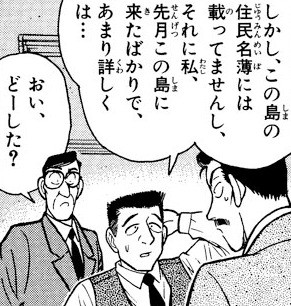
Kogoro has received a letter and a phone call from a man named Asou Keiji, who paid in advance and demanded he come to Tsukikage Island. Kogoro, Ran, and Conan take a boat to the island. At the village office, the clerk says nobody by that name lives there, and Kogoro insists he got a letter from him.
- 職員:
- 「しかし、この島の住民名簿には載ってませんし、それに私、先月この島に来たばかりで、あまり詳しくは…」
- “But he's not in the island's register of residents, and besides, I only came to this island last month, so I don't know much about...”
- 年配の職員:
- 「おい、どーした?」
- “Hey, what's going on?”
Key Points
- The た-form 来た plus ばかり says the clerk arrived on the island not long ago.
- A month has passed since then, but ばかり only needs the time to feel short to the speaker. 先月 sets the time, and ばかり frames it as recent.
- で, the て-form of だ, links his recent arrival to what follows: he can’t tell Kogoro much.
- The clerk has already said Asou isn’t in the register. His recent arrival is a second reason not to expect more from him.
- This is a common use of たばかりで. The speaker gives a recent event as the reason they can’t help or can’t be expected to know something.
- 載ってません is 載っていません, “isn’t listed”, with the い of ている dropped, as often happens in speech.
- し after it marks this as one reason among others. それに, “besides”, introduces the next one.
- あまり with a negative means “not very”. The full thought would be something like あまり詳しくはありません, “I’m not very familiar with it”.
- The clerk stops before the negative ending. Leaving it unsaid softens the refusal.
- は after 詳しく contrasts: he may know a little, but not in any detail.
- The older worker asks what is going on. どーした spells the long vowel of どう with a dash, as manga often do for casual speech.
Vocabulary
この (This)
この means “this” or “these” and comes directly before a noun. It points to something near the speaker or something the speaker is referring to in the conversation.
島 (Island)
島 is an island, a piece of land surrounded by water.
載る (To be listed)
載る means to appear in print or be recorded in something, such as a list, a newspaper, or a dictionary. It can also mean to be placed or loaded on top of something.
私 (I)
私 means “I” or “me”. It is the standard first-person pronoun in polite speech and is also common in casual speech among women.
来る (To come)
来る means to come or move toward the speaker or the place being discussed.
あまり (Not very)
あまり with a negative means “not very” or “not much”. Without a negative, it means “too” or “excessively”. In casual speech it often becomes あんまり.
詳しい (Detailed)
詳しい describes something detailed or thorough, such as an explanation. Said of a person, it means knowing a lot about a subject or place.
どう (How)
どう asks about the way or state of something: “how” or “how about”. It also appears in どうしよう, “what should I do?”
する (To do)
する is to do or perform something. It also turns many nouns into verbs, as in 勉強する.
See Also
- Grammar: Just happened with 〜た+ばかり
- Grammar: In addition to with それに〜
- Grammar: Ongoing actions and resulting states with 〜ている
- Grammar: How casual contractions work
- Kanji: Privacy and self with 私