Only dodging and never attacking with 〜ばかり
Grammar Explanation: Nothing but with 〜ばかり
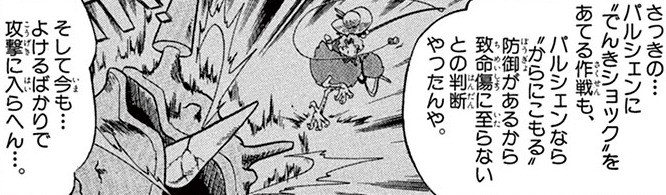
Kanna of the Elite Four has Yellow and Masaki under attack with ice missiles fired by her Cloyster and Dewgong. Yellow hits Cloyster with Thunder Shock, which keeps it from firing, and the two escape on Yellow’s Dodo. When Kanna attacks again, Dodo only dodges. Masaki asks why Yellow won’t fight back, and Yellow says they should run. Masaki then realizes that Yellow is trying not to hurt anyone, friend or enemy.
- マサキ:
- 「さっきの…パルシェンに〝でんきショック〟をあてる作戦も、パルシェンなら〝からにこもる〟防御があるから致命傷に至らないとの判断やったんや。」
- “That plan earlier, hitting Cloyster with Thunder Shock... he'd figured Cloyster could defend itself with Withdraw, so the hit wouldn't be fatal.”
- 「そして今も…よけるばかりで攻撃に入らへん…。」
- “And now too... he's only dodging, and he won't go on the attack...”
Key Points
- After a verb’s dictionary form, ばかり says that action is the only thing happening. よけるばかり is “doing nothing but dodge”.
- で links it to the next clause, which says what isn’t happening: 攻撃に入らへん. The same shape shows up in 言うばかりで、何もしない, “all talk and no action”.
- Masaki isn’t complaining here, even though ばかり often sounds critical. In the previous panel, he wanted Yellow to counterattack, but now he understands why Yellow holds back.
- Masaki speaks Kansai dialect, where へん replaces the negative ない. 入らない becomes 入らへん.
- 攻撃に入る means “to go on the attack”, that is, to switch from defense to offense.
- やった is Kansai for だった, and んや is Kansai for んだ. 判断やったんや corresponds to standard 判断だったんだ, “so that was his judgment”.
- との turns everything before it into the content of the judgment: “the judgment that Cloyster would not take a fatal hit”.
- The んや sentence is Masaki’s realization. Yellow aimed the earlier Thunder Shock with Cloyster’s safety in mind.
- In 作戦も and 今も, も sets the earlier plan and the current dodging side by side as two pieces of evidence.
- Both back up Masaki’s realization in the previous panel, 敵も味方も傷つけまいとしとるんや, “he’s trying not to hurt friend or foe”.
Vocabulary
さっき (A moment ago)
さっき is a short time before now.
あてる (To hit)
あてる means to make something hit or touch a target, such as a ball, an attack, or a hand on someone’s forehead. It also means to guess correctly or to win a prize. It is often written 当てる.
作戦 (Strategy)
作戦 means a plan for carrying out an operation. It often refers to military strategy, but it also works for everyday plans and schemes.
ある (To exist)
ある is to exist or be in a place, for things and plants rather than people or animals. It also means to have something, or for an event to take place.
至る (To reach)
至る means to reach a place, stage, or result, as in 結論に至る, “to reach a conclusion”. 致命傷に至らない means an injury doesn’t go so far as to be fatal.
今 (Now)
今 is the present moment, or these days.
よける (To dodge)
よける means to move out of the way of something, such as a blow, a puddle, or a passing car. It also means to set something aside. It is also written 避ける.
入る (To enter)
入る is to go into a place, or for something to be inside. It also means to join a club or school.
See Also
- Grammar: Nothing but with 〜ばかり
- Grammar: Grammar in the Kansai dialect
- Grammar: Negation with 〜ない
- Grammar: Reasoning with 〜のだ
- Kanji: Cutting off and decision with 断
- Kanji: Entering and putting in with 入
- Kanji: Making and creating things with 作
- Kanji: Now and the present with 今