Packing the side dishes with お弁当箱につめる
Vocabulary Explanation: Collocations for cooking
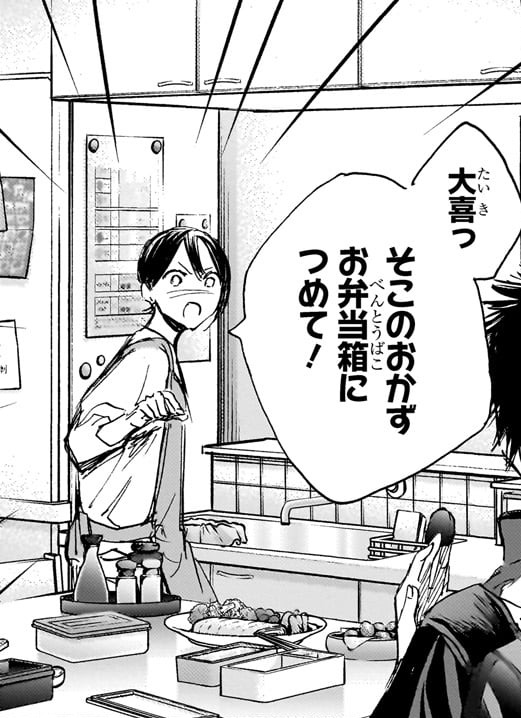
It’s morning at the Inomata house. Taiki shuffles into the kitchen half asleep and mumbles a good morning to his mother, who is at the counter getting the day’s lunches ready.
- お母さん:
- 「大喜っ そこのおかずお弁当箱につめて!」
- “Taiki! Pack those side dishes into the lunch boxes!”
- Literal: “Taiki! Pack the side dishes there into the lunch boxes!”
Key Points
1おかずを弁当箱に詰める = to pack the side dishes into a lunch box
- 詰める means to pack or stuff something into a container until it’s full. Japanese uses it for filling a lunch box: you don’t put food in a lunch box, you 詰める it. She writes the verb in kana, つめて.
- The parts follow a fixed pattern: the food takes を, and the container takes に. The same pattern shows up outside the kitchen, as in 荷物をかばんに詰める, “to pack your things into a bag.”
- おかず are the dishes eaten alongside rice. In a お弁当, they fill one section of the box and rice fills the other.
2The dropped を
- In full, the line would be おかずをお弁当箱につめて. Casual speech often drops を, especially in a quick instruction like this one. に stays because it shows where the food goes.
3そこの = the ones there
- そこの points to things near the listener or within reach. She means the food already laid out on the counter.
4つめて! = a casual request
- A bare て-form works as a request between family members. Without ください or ね, it sounds hurried, which fits a parent rushing through the morning.
- The small っ in 大喜っ cuts the name short and makes it sound like a sharp call to get his attention.
Vocabulary
そこ (There)
そこ points to a place near the listener or one just mentioned. It can also point to a matter just raised, as in そこは “on that point”.
おかず (Side dish)
おかず is a dish eaten with rice, such as meat, fish, or vegetables.
つめる (To pack; to stuff)
つめる means to pack things tightly into a container, such as food into a lunch box or clothes into a bag. It also means to close up a gap, as when people squeeze together to make room. It is also written 詰める.
See Also
- Vocabulary: Collocations for cooking
- Grammar: Requests with 〜てください and 〜てくれ
- Kanji: Matching and appropriateness with 当
アオのハコ © its respective creators. It is used here for educational commentary.