Peeling a daikon Ayune's way with 皮を剥く
Vocabulary Explanation: Collocations for cooking
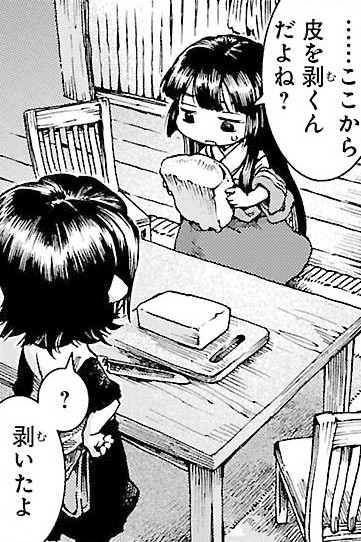
Mikochi’s older sister Ayune has turned up unannounced to stay. She brought a whole daikon for steamed daikon, far more than they need, and Mikochi puts her to work peeling it. Ayune agrees cheerfully, then takes a big knife to the daikon and slices it with a few hard chops.
- ミコチ:
- 「……ここから皮を剥くんだよね?」
- “...You're going to peel this part next, right?”
- アユネ:
- 「? 剥いたよ」
- “Huh? I already peeled it.”
Key Points
1皮を剥く = to peel
- 剥く means to peel or strip off an outer layer, and 皮を剥く is the standard phrase for peeling fruit and vegetables. It’s often written in kana: 皮をむく.
- Mikochi’s request in an earlier panel used the noun form: それの皮剥きをお願い, “please peel that”. 皮剥き is “peeling” as a task.
- Peeling a daikon usually means a thin layer. Ayune’s chops cut away far more.
2ここから = from here
- から marks a starting point. Mikochi holds up the slab and asks whether this is where the peeling happens: “you’re going to peel it from here”.
3〜んだよね = checking an assumption
- んだ treats the statement as Mikochi’s understanding of the situation, and よね asks Ayune to confirm it. Mikochi is fairly sure, but the trailing dots and the sweat show she’s starting to doubt it.
4剥いたよ = I already peeled it
- 剥いた is the た-form of 剥く. Here it means the job is done: “I peeled it” or “I already peeled it”.
- よ tells Mikochi something she doesn’t seem to know. Ayune’s ? shows she can’t see why Mikochi is asking.
Vocabulary
ここ (Here)
ここ is the place where the speaker is.
皮 (Skin)
皮 is the outer covering of something: the skin or peel of fruit and vegetables, an animal’s hide, or the bark of a tree.
剥く (To peel)
剥く is to strip off an outer layer, such as the skin of fruit or vegetables. It is often written in kana as むく.
See Also
- Vocabulary: Collocations for cooking
- Grammar: Seeking agreement with ね
- Grammar: Reasoning with 〜のだ
- Grammar: Past tense with 〜た・〜だ
- Grammar: Informing with よ
ハクメイとミコチ © its respective creators. It is used here for educational commentary.