Photographs of deceased parents with 写真
Kanji Explanation: Copying and representation with 写 (Future entry)
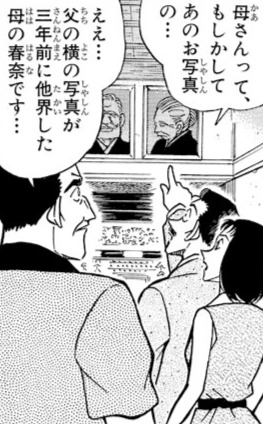
Kogoro takes a client to the home of someone she’d be communicating with via pagers. They show the household family a music box that was left to the client by her correspondence partner. The music it plays reminds the homeowner of the koto his mother used to play.
- 小五郎:
- 「母さんってもしかしてあのお写真の…」
- “By 'Mom', could that be the one in that photo…?”
- Literal: “By 'mother', could you mean the one in that photo...?”
- 常雄:
- 「ええ… 父の横の写真が三年前に他界した母の春菜です…」
- “Yes... The photo beside my father's is my mother, Haruna, who passed away three years ago...”
- Literal: “Yes... the photo beside my father's is of my mother Haruna, who passed away three years ago...”
Key Points
- The kanji 写 points to copying or reproducing an image, so 写真 is a “true copy” in the sense of a photograph.
- Kogoro starts to ask whether “Mom” is the person in that photo, but trails off after の.
- A fuller version would be あのお写真の人, “the person in that photo”.
- This stacks two の phrases: 父の横 means “beside my father”, and the second の links that location to 写真.
- The phrase identifies which photo he means: the photo beside his father’s photo.
- 三年前に他界した modifies 母, giving “my mother, who passed away three years ago”.
- 他界 is more formal and softened than simply saying 死んだ.
Vocabulary
あの (That)
あの comes before a noun to mean “that” or “those”. It points to someone or something away from both speakers, or something they both know about.
写真 (Photograph)
写真 means a photograph or photo.
三年 (Three years)
三年 means three years. It can describe a length of time or the third year of a program or era, depending on context.
他界 (Passing away)
他界 is a respectful euphemism for a person’s death.
See Also
- Future entry: Past tense with 〜た・〜だ
- Kanji: Boundaries and worlds with 界