Picking the taranome clean with 採り尽くす
Vocabulary Explanation: Taking, catching, and photographing with とる
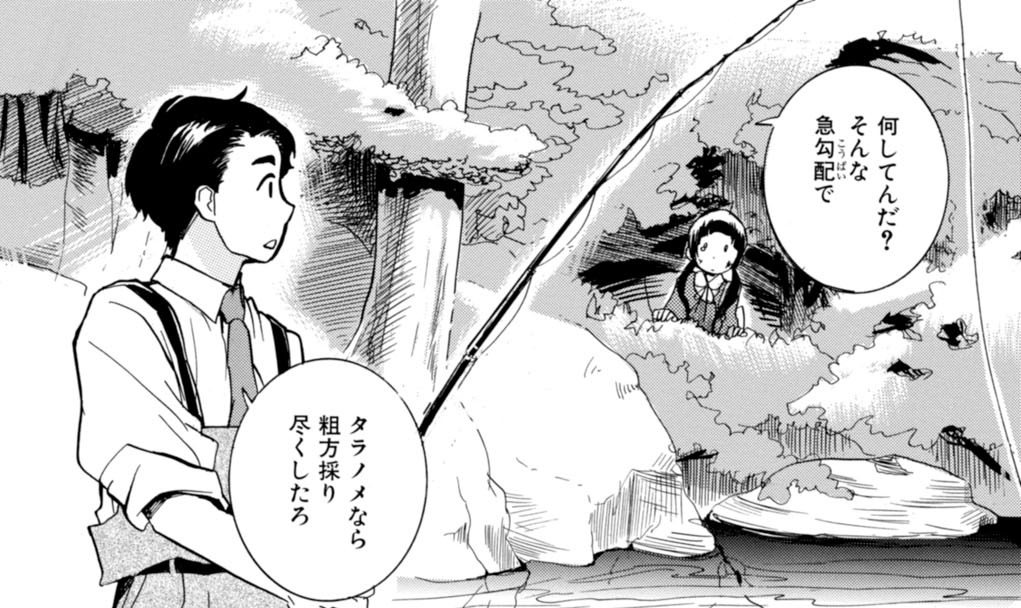
Machi sets out for the Uniqlo in town, but the heavy bicycle she borrowed breaks down on the mountain road. She decides to cut straight across the mountain on foot and pushes through the undergrowth until she comes out above a stream. Yoshio is standing in it with a fishing rod, and he’s surprised to see her up on the slope.
- 良夫:
- 「何してんだ? そんな急勾配で」
- “What are you doing up on a slope that steep?”
- 「タラノメなら粗方採り尽くしたろ」
- “If you're after taranome, we've pretty much picked them all already, haven't we?”
Key Points
- 採る is gathering something that grows, such as 山菜, wild mountain vegetables. Taranome are one of the best known, the spring shoots of the Japanese angelica tree, so the writer uses 採 rather than the default 取. 取り尽くす would also be understood, but 採 says these were picked from plants.
- 尽くす after a verb stem means doing it until there’s nothing left: 食べ尽くす is “eat it all” and 使い尽くす is “use it all up”. 採り尽くす is picking a place clean.
- 粗方 means “mostly” or “nearly all”. Some shoots may be left, but not enough to be worth the climb.
- なら picks up a reason Yoshio guesses for Machi being on the slope and answers it. He assumes she’s foraging, since that’s what people climb those slopes for in spring.
- ろ here is だろ with the だ dropped, a rough, casual way to say 採り尽くしただろう. He’s not really asking. He expects her to agree it’s common knowledge in the village.
- 何してんだ is 何をしているんだ in casual speech. を drops, and ている shrinks to てる, then to てん before だ.
- そんな急勾配で comes after the question as an afterthought: “on such a steep slope”.
Vocabulary
| Word | English | Meaning |
|---|---|---|
| 何 | What | 何 asks what something is. It is read なに, or なん before certain sounds. |
| する | To do | する is to do or perform something. It also turns many nouns into verbs, as in 勉強する. |
| そんな | Like that | そんな describes something like the thing just mentioned. Said alone, it shows shock or denial: “no way!” |
| 急勾配 | Steep slope | 急勾配 is a steep slope, like a hard hill on a bike. |
| タラノメ | Angelica tree shoots | タラノメ are the young spring shoots of the Japanese angelica tree, picked in the mountains as a wild vegetable and often eaten as tempura. It is also written たらの芽. |
| 粗方 | Mostly; nearly all | 粗方 means for the most part or nearly all, leaving only a little out. It is often written in kana as あらかた. |
| 採る | To gather; to pick | 採る is to gather something that grows or can be collected, such as mushrooms or wild vegetables. It also means to pick one option from several, or to hire someone. |
| 尽くす | To use up; to devote oneself | 尽くす is to use something up or do it to the fullest. After another verb’s stem it means doing that until nothing is left, as in 食べ尽くす, “eat it all”. It also means giving your all for someone, as in 国に尽くす, “serve one’s country”. |
See Also
- Vocabulary: Taking, catching, and photographing with とる
- Grammar: If that's the case with なら
- Grammar: Presuming with 〜だろう and 〜でしょう
- Grammar: How casual contractions work
- Kanji: Distribution and arrangement with 配