Picking up Kyoto dialect with 〜ようになる
Grammar Explanation: Coming to do with 〜ようになる
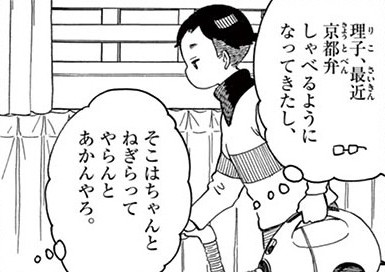
The dance teacher and the house mistress send the maiko off with おきばりやす, “keep up the good work”. Later, over a cup of tea, Tsurukoma decides the phrase sounds cool and wants to say it herself. Watching Riko, the new trainee, vacuum the room, she realizes she could say it to her own junior.
- つる駒:
- 「理子、最近京都弁しゃべるようになってきたし、」
- “Riko's started speaking Kyoto dialect lately...”
- Literal: “Riko has lately been coming to speak Kyoto dialect, and...”
- 「そこはちゃんとねぎらってやらんとあかんやろ。」
- “...so I really ought to give her some credit for that.”
- Literal: “...on that point, I have to properly recognize her effort, right?”
Key Points
- ようになる after a dictionary-form verb says someone has started doing something they didn’t do before. しゃべるようになる is “come to speak”.
- てきた adds that the change has been building up gradually up to now. With 最近, “lately”, the line says Riko has been picking up Kyoto speech over recent weeks.
- Riko usually talks in casual standard Japanese, with endings like っス. Tsurukoma has noticed Kyoto speech creeping in.
- Casual speech often drops を, so 京都弁しゃべる is 京都弁をしゃべる.
- し after a clause gives a reason, often one of several, with the others left unsaid. Here it gives Tsurukoma her excuse: since Riko is making progress, she deserves a word of praise.
- ねぎらう is to thank or praise someone for their hard work. It’s usually said by someone senior to someone junior, the same way おきばりやす is.
- 〜てやる is a blunter 〜てあげる, for doing something for someone below you. Riko is the newest member of the house.
- やらんとあかん is Kansai speech for やらないといけない, “have to do”. ん is the Kansai negative ない, and あかん means “no good”.
- やろ is Kansai for だろう. Here she seeks agreement from no one but herself: “that’s only right, isn’t it?”
- そこは points back to Riko’s progress: “for that, at least”. ちゃんと is “properly”. She’s building a case for doing what she already wanted to do, which is say おきばりやす.
Vocabulary
弁 (Dialect)
弁 after a place name means that place’s dialect or accent, as in 京都弁 “Kyoto dialect” and 関西弁 “Kansai dialect”.
しゃべる (To talk)
しゃべる is to talk or chat, usually in a casual, everyday way.
よう (Way)
よう follows a word to show a way or manner, or that something seems a certain way. ようになる means to reach a point where something happens. It is also written 様.
なる (To become)
なる is to change into a different state or become something. It also means something turns out a certain way. It is also written 成る.
くる (To come)
くる is to move toward the speaker or the place being talked about. After a て-form verb, it shows a change coming about, or going and coming back. It is the kana spelling of 来る.
そこ (There)
そこ points to a place near the listener or one just mentioned. It can also point to a matter just raised, as in そこは “on that point”.
ちゃんと (Properly)
ちゃんと describes doing something correctly and with care, the way it should be done.
ねぎらう (To show appreciation)
ねぎらう is to thank or praise someone for their hard work. It’s usually said to someone of equal or lower status.
やる (To do)
やる is a casual word for “to do”. It also means to give something to someone of lower standing, or to animals and plants.
See Also
- Grammar: Coming to do with 〜ようになる
- Grammar: Grammar in the Kansai dialect
- Grammar: Must do with 〜なければならない
- Grammar: Doing for someone with 〜てあげる