Place of part-time job with 〜先
Vocabulary Explanation: Place where something is done with 〜先
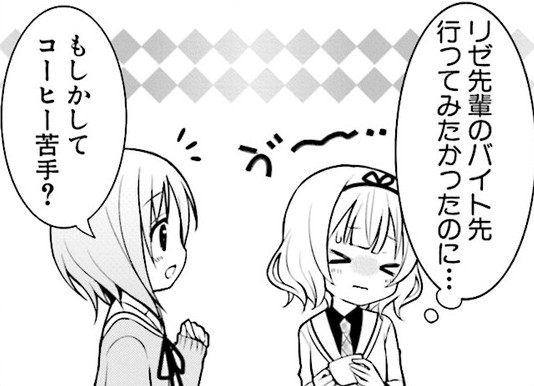
Syaro explains the qualities of a shop’s tea cup, but Rize points out that her workplace primarily sells coffee.
- シャロ:
- 「リゼ先輩のバイト先行ってみたかったのに…」
- “I wanted to try going to Rize-senpai's part-time workplace...”
- ココア:
- 「もしかしてコーヒー苦手?」
- “Do you not like coffee?”
Key Points
- 〜先 names the place associated with the activity.
- Syaro had wanted to try visiting Rize’s workplace. The destination particle に after バイト先 is omitted in the casual line.
- The final のに… implies that something prevented the visit, even though Syaro had wanted to go.
- Cocoa tentatively asks whether coffee is something Syaro dislikes or has trouble with. The casual question leaves なの? or ですか? unstated.
Vocabulary
| Word | English | Meaning |
|---|---|---|
| 先輩 | Senior | 先輩 is a senior member of the same school, workplace, or group, usually someone who joined earlier or has more experience. |
| バイト | Part-time job | バイト is short for アルバイト, a part-time job. |
| 先 | Ahead | 先 is the front or tip of something, what comes ahead, or a place one goes to, as in バイト先, one’s workplace. |
| 行く | To go | 行く means to go or move toward a place away from the speaker. |
| みる | To see | みる is the kana spelling of 見る, “to see”. After a て-form verb, it means to try doing something to see how it goes. |
| もしかして | Perhaps | もしかして introduces a guess the speaker is unsure about: “could it be that…?” |
| コーヒー | Coffee | コーヒー is coffee, the drink made from roasted coffee beans. |
| 苦手 | Weak point | 苦手 means something one is bad at or someone one finds difficult to deal with. |
See Also
- Vocabulary: Place where something is done with 〜先
- Grammar: Past tense with 〜た・〜だ
- Grammar: Trying it out with 〜てみる
- Grammar: Wanting to do with 〜たい
- Grammar: Even though with 〜のに
- Kanji: Going and carrying out with 行
- Kanji: Hands and skill with 手