Placing the chocolate while his back is turned with 〜間に
Grammar Explanation: During the same time with 〜間(に)
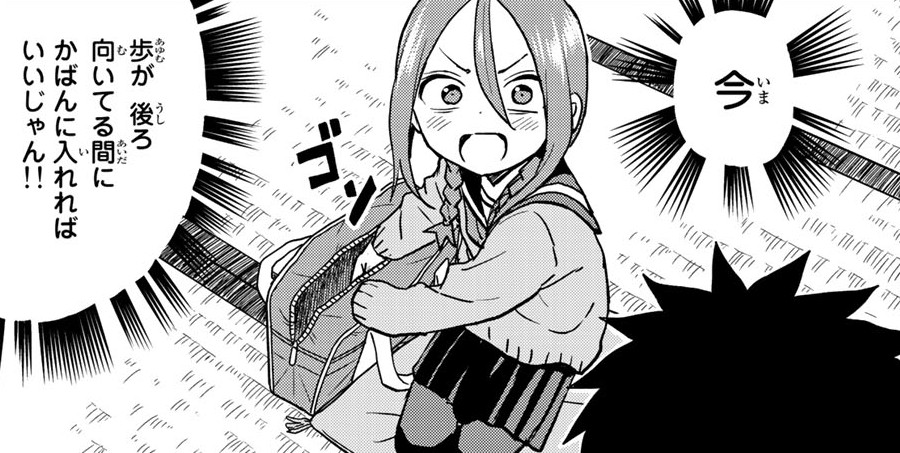
Urushi prepared chocolate to give Ayumu for Valentine’s Day but is too nervous to give it to him. After the two play shogi during their club, Ayumu turns away from Urushi as he puts the shogi table away.
- うるし:
- 「今。歩が 後ろ向いてる間にかばんに入れればいいじゃん!!」
- “Now! While Ayumu's back is turned, I can just put it into his satchel!”
- Literal: “Now. It would be fine if I put it in his bag during the time Ayumu is facing away!”
Key Points
- 〜間に means that one action happens during the span of another action or state.
- Urushi wants to put the chocolate in his bag during the time Ayumu is facing away.
- 向いてる is shortened from 向いている.
- It describes Ayumu’s ongoing state: his back is turned right now.
- 〜ればいい means “it would be good if…” or “all I have to do is…”.
- The casual じゃん adds the feeling that Urushi has just realized the obvious move.
Vocabulary
| Word | English | Meaning |
|---|---|---|
| 今 | Now | 今 is the present moment, or these days. |
| 後ろ | Behind | 後ろ is the back side of something, or the area behind it. |
| 向く | To face | 向く is to turn toward a direction. It also means to be suited for something. |
| 間 | While | 間 is the space or time between two things. 〜の間 means “while” or “during”. |
| かばん | Bag | かばん is a bag for carrying things, such as a school bag or briefcase. |
| 入れる | To put in | 入れる is to put something inside something else. It also means to let someone in, or to make tea or coffee. |
| いい | Good | いい describes something good, nice, or fine. It can also mean “okay” or “that’s enough”. Its other forms come from よい, as in よくない and よかった. |
See Also
- Grammar: During the same time with 〜間(に)
- Grammar: The copula だ
- Future entry: Transitivity in Japanese
- Grammar: Hypothetical condition with 〜ば
- Kanji: After and behind with 後
- Kanji: Entering and putting in with 入
- Kanji: Now and the present with 今
- Kanji: Spaces and intervals with 間