Please let me hold the baby pandas with 〜させてください
Grammar Explanation: Please let me with 〜させてください
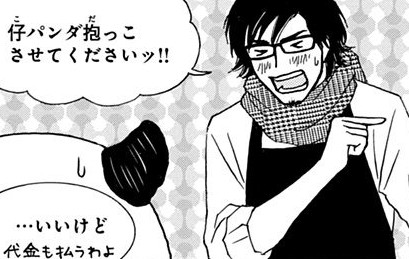
Rin Rin loves pandas such that when he makes a delivery to Panda’s home, he can’t resist the cuteness of the younger siblings. Panda Mama takes out her purse to cover the cost of the delivery, but Rin Rin refuses to accept payment.
- リンリン:
- 「仔パンダ抱っこさせてくださいッ!!」
- “Please let me hold the baby pandas!!”
- Literal: “Please let me hold the baby pandas!!”
- パンダママ:
- 「…いいけど 代金も払うわよ」
- “That's fine, but... I'll also pay the bill!”
- Literal: “...That's fine, but I'll pay the fee too.”
Key Points
1抱っこさせてください asks permission to hold them
- 抱っこする means “to hold” or “to cuddle” a small child or animal.
- The する part becomes the causative させる, so 抱っこさせてください means “please let me hold them”.
2仔パンダを: the object particle is omitted
- A fuller version is 仔パンダを抱っこさせてください.
- The baby pandas are clearly what Rin Rin wants to hold, so casual speech can leave を unstated.
3させてください is not making someone else act here
- In this request, Rin Rin is asking Panda Mama to allow him to do the action.
- Read it as “let me hold the baby pandas”, not “make the baby pandas hold something”.
4…いいけど grants permission, then pivots
- Panda Mama’s いいけど means “that’s fine, but…” and accepts the holding request.
- The けど leads into her added point: she still intends to pay the delivery fee.
Vocabulary
| Word | English | Meaning |
|---|---|---|
| 仔 | Young animal | 仔 is a young animal, like a cub or pup. Pet owners also use it for their pets. |
| パンダ | Panda | パンダ is a panda. |
| 抱っこ | Holding | 抱っこ is holding a child or small animal in one’s arms. |
| いい | Good | いい describes something good, nice, or fine. It can also mean “okay” or “that’s enough”. Its other forms come from よい, as in よくない and よかった. |
| 代金 | Price | 代金 is the money paid for something bought or for a service. |
| 払う | To pay | 払う is to pay money. It also means to brush or sweep something away. |
See Also
- Grammar: Please let me with 〜させてください
- Grammar: Informing with よ
- Grammar: But with 〜けど and 〜けれど
しろくまカフェ bis © its respective creators. It is used here for educational commentary.