Practicing for this day with 〜ために
Grammar Explanation: Purpose and cause with 〜ために
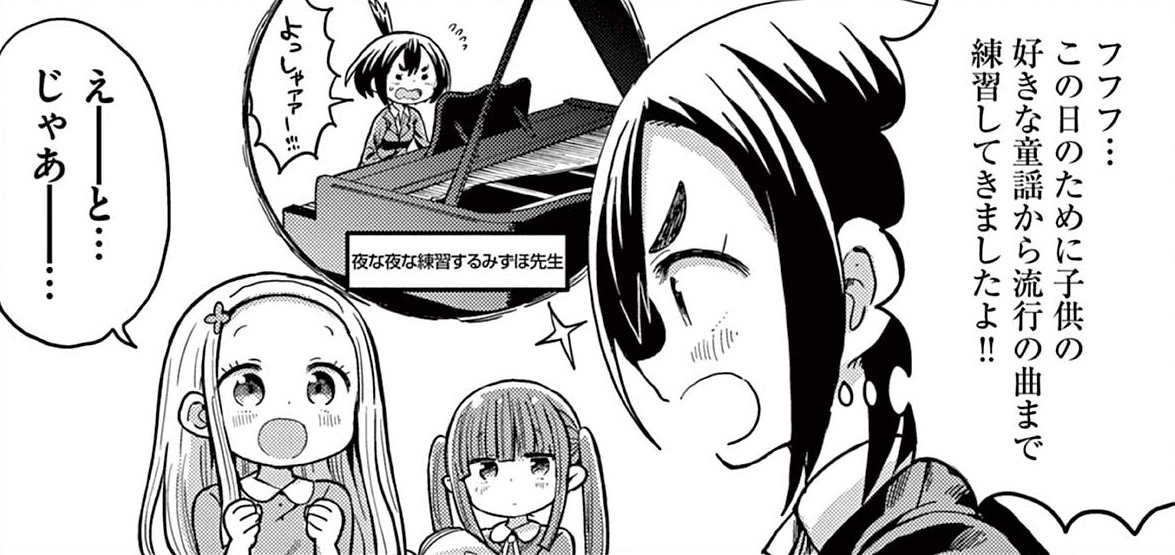
Mizuho-sensei is a new teacher. During her student teaching in Tokyo, a class survey called her lessons boring, and she wants her first graders to have fun. Today she is leading them on a school exploration. In the music room, the children crowd around the grand piano, and Sami asks whether it plays any songs. Mizuho-sensei sees her chance. She sits down at the piano, offers to play, and asks the class for requests.
- みずほ先生:
- 「フフフ… この日のために子供の好きな童謡から流行の曲まで練習してきましたよ!!」
- “Heh heh heh... For this day, I've practiced everything from the nursery rhymes kids love to the latest hits!!”
- みずほ先生:
- 「よっしゃアー!!!」
- “Yeahhh!!!”
- ◯:
- 「夜な夜な練習するみずほ先生」
- “Mizuho-sensei, practicing night after night”
- サミ:
- 「えーーと… じゃあーー…」
- “Ummm... Okay, then...”
Key Points
- ために names the goal an action serves. After a noun, の links the noun to it, so この日のために means “for this day”.
- この日 is the day of the school exploration. Mizuho-sensei practiced so she would be ready the moment the children asked her to play.
- A verb takes ために directly, with no の. 授業で弾くために練習した means “I practiced to play it in class.”
- から marks one end of a range and まで marks the other. 子供の好きな童謡から流行の曲まで means “from the nursery rhymes kids like to the songs that are popular now”.
- Naming two far-apart ends implies she covered everything between them. She is ready for any request.
- Inside a clause that describes a noun, の can replace the subject marker が. 子供の好きな童謡 means the same as 子供が好きな童謡, “nursery rhymes that kids like”.
- The kids are the ones who like the songs. This の does not mean the songs belong to them.
- After an action, 〜てくる can show that it went on from the past up to the present. 練習してきた says the practice built up over many days and leads to today.
- The inset shows what that practice looked like. Its caption, 夜な夜な練習するみずほ先生, means “Mizuho-sensei, practicing night after night”.
- Mizuho-sensei speaks to her students in polite ます form. The よ at the end announces her news to the class with some pride.
- えーと fills the pause while Sami thinks. じゃあ, “well then”, leads into her request, which comes in the next panel.
Vocabulary
この (This)
この means “this” or “these” and comes directly before a noun. It points to something near the speaker or something the speaker is referring to in the conversation.
日 (Day)
日 is a day. It also means the sun or sunlight.
ため (For)
ため is the purpose or benefit of something: 〜のため means “for the sake of” or “in order to”. It can also give a cause: “because of”. It is also written 為.
子供 (Child)
子供 is the everyday word for a child. It can also refer to children as a group.
好き (Liked)
好き describes something you like or someone you love.
曲 (Song)
曲 is a piece of music or song.
練習 (Practice)
練習 means practice or rehearsal done to improve a skill or performance.
する (To do)
する is to do or perform something. It also turns many nouns into verbs, as in 勉強する.
くる (To come)
くる is to move toward the speaker or the place being talked about. After a て-form verb, it shows a change coming about, or going and coming back. It is the kana spelling of 来る.
夜な夜な (Night after night)
夜な夜な describes something that happens every night, one night after another.
先生 (Teacher)
先生 is a respectful title for teachers and certain professionals, including doctors, lawyers, and politicians. Speakers do not normally use it for themselves.
See Also
- Grammar: Purpose and cause with 〜ために
- Grammar: Until an action occurs with 〜まで
- Grammar: Polite style with です and ます
- Grammar: Informing with よ
- Kanji: Childhood and small things with 子
- Kanji: Going and carrying out with 行