Praising rice from the new cooker with 米を炊く
Vocabulary Explanation: Collocations for cooking
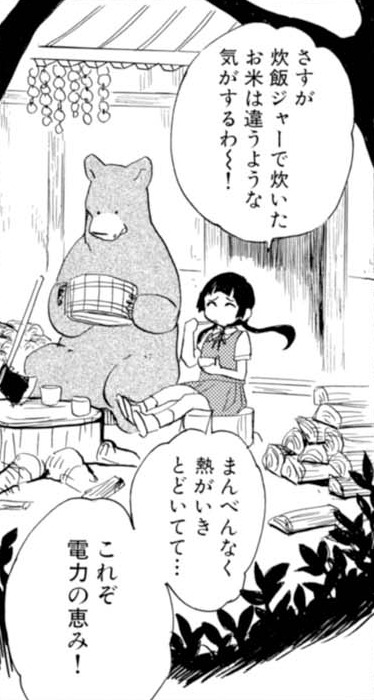
Machi has always cooked rice over a wood fire, so Natsu brings her a new pressure IH rice cooker. The appliance frightens her so much that she nearly gives up, but Natsu talks her into trying again. Now the rice is ready, and Machi takes her first bite.
- まち:
- 「さすが炊飯ジャーで炊いたお米は違うような気がするわ~!」
- “I just knew it! Rice cooked in a rice cooker feels different somehow!”
- Literal: “As expected, I feel like rice cooked in a rice cooker is different!”
- 「まんべんなく熱がいきとどいてて…」
- “The heat reaches every grain evenly...”
- 「これぞ電力の恵み!」
- “This is the blessing of electricity!”
Key Points
- 炊く is the verb for cooking rice, by boiling it until the water is absorbed. Japanese doesn’t use 料理する or 煮る for this.
- Machi turns the phrase around. 炊いた comes before お米 and describes it: 炊いたお米, rice that was cooked. The particle で marks what it was cooked in, the 炊飯ジャー.
- The appliance’s name shares the kanji: 炊飯 is 炊 “cook” plus 飯 “rice”. Short for 炊飯器, it mean a rice cooker.
- さすが says something meets the high expectations people have of it. 〜は違う finishes the thought: it’s a cut above the ordinary.
- Machi has heard that city people all use these cookers, so she expects great things from it.
- 気がする turns a statement into an impression, “I feel like.” ような before it makes the impression vaguer still.
- The hedge is part of the joke. Natsu answers that the credit goes to 火力, firepower, and not 電力. Machi cooked the rice in the cooker’s inner pot over her wood stove.
- まんべんなく means evenly, with nothing missed. いきとどく (行き届く) means to reach every part.
- いきとどいてて is いきとどいていて with the い dropped. The 〜ている shows a state: the heat has reached every grain. The final て leaves the sentence trailing off.
- ぞ after これ adds emphasis, like これこそ. これぞ電力の恵み means “this, right here, is the blessing of electricity.”
Vocabulary
さすが (As expected)
さすが shows that someone did just as well as you would expect from them: “that’s so-and-so for you”.
炊飯ジャー (Rice cooker)
炊飯ジャー is an electric rice cooker that also keeps the rice warm after cooking. It is another name for a 炊飯器.
炊く (To cook rice)
炊く is to cook rice or other grains by boiling them until the water is absorbed, as in ご飯を炊く. In western Japan, it also means to simmer other foods.
お米 (Rice)
お米 is uncooked rice, the grains before they are cooked. The お makes it sound polite and gentle, and most speakers use it in everyday talk. Once cooked, rice is called ご飯.
違う (To differ)
違う is to be different from something. It also means to be wrong.
気 (Spirit)
気 is a person’s mind, mood, or feelings. It appears in many expressions, such as 気がする, “to have a feeling”.
する (To do)
する is to do or perform something. It also turns many nouns into verbs, as in 勉強する.
まんべんなく (Evenly)
まんべんなく means evenly, all over, with no part left out.
熱 (Heat)
熱 is heat. It is also a fever, as in 熱がある, and the craze or keenness people have for something.
いきとどく (To reach every part)
いきとどく means to reach every corner of something. It often describes care or attention that is thorough, as in 掃除がいきとどく, “the cleaning is thorough”. It is also written 行き届く.
恵み (Blessing)
恵み is a blessing or gift, something good received from nature, heaven, or another person, as in 自然の恵み.
See Also
- Vocabulary: Collocations for cooking
- Grammar: Thinking or feeling something with 〜気がする
- Grammar: Evidence-based guessing with 〜ようだ
- Kanji: Electricity and communication with 電