Preparing to contact Asuka Jr. with 連絡
Kanji Explanation: Connection and entanglement with 絡 (Future entry)
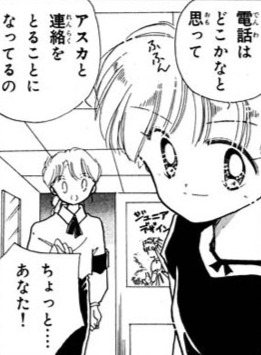
Takamiya suspects Meimi is the magical thief Saint Tail. When Meimi is asked to model a wedding dress for a design contest where Saint Tail is going to appear, Takamiya decides to keep a close eye on her at the event. As Takamiya looks around the dressing room, Meimi asks what she’s doing.
- 高宮:
- 「電話はどこかなと思って」
- “I was just wondering where the phone is.”
- 「アスカと連絡をとることになってるの」
- “I'm supposed to get in touch with Asuka.”
- Literal: “It has been arranged that I will contact Asuka.”
- スタッフ:
- 「ちょっと…あなた!」
- “Hey… you!”
Key Points
- Here 連絡 means making contact with someone.
- アスカと 連絡をとる means “contact Asuka”.
- The particle と marks the person Takamiya will be in contact with, and を marks 連絡 as the thing being made or established.
- アスカと 連絡をとることになってる means “it’s been arranged that I’ll contact Asuka”.
- This is the casual spoken form of ことになっている.
- It suggests an external arrangement or understood plan, not just a spur-of-the-moment personal decision.
- The final の makes her line sound explanatory, like she is giving the reason for looking for the phone.
Vocabulary
電話 (Telephone)
電話 means a telephone, phone call, or the act of calling someone.
どこか (Somewhere)
どこか is some place that is not named or not known.
思う (Think)
思う is to have a thought, feeling, belief, or hope about something.
連絡 (Contact)
連絡 means contacting someone or passing along information. It can also mean a connection between things.
とる (To be doing)
とる is a western Japanese contraction of ておる, the same as ている in standard Japanese: “to be doing”.
こと (Thing)
こと is an abstract thing, matter, or fact, as opposed to a physical object. It also turns a verb phrase into a noun, as in 見たことがある. It is also written 事.
なる (To become)
なる is to change into a different state or become something. It also means something turns out a certain way. It is also written 成る.
ちょっと (A little)
ちょっと describes a small amount or a short time. It also softens a refusal, or calls someone’s attention, like “hey”.
あなた (You)
あなた is a polite word for the person you are speaking to. Japanese speakers often avoid it and use the person’s name or title instead. A wife may also call her husband あなた.
See Also
- Grammar: Quoting and reporting with と and って
- Grammar: Past decision still in effect with 〜ことになっている
- Grammar: Marking the topic with は and も
- Grammar: Wondering with かな
- Kanji: Electricity and communication with 電
- Kanji: Linking and succession with 連