Proportional to the degree of time passed with 〜ば〜ほど
Grammar Explanation: Proportional to with 〜ば〜ほど
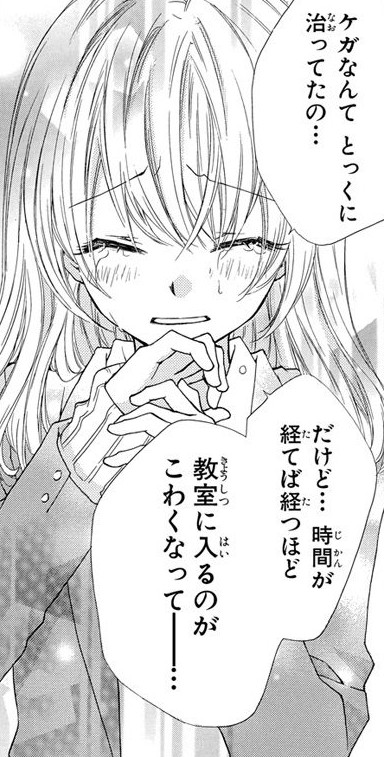
After a traffic accident sends Hiyori to the hospital, she misses the first few months of the school year. Once she’s finally able to attend, an embarrassing situation occurs, and she runs out of the classroom and hides. Yuushin tracks her down, and Hiyori tells him she should never have come to school.
- ひより:
- 「ケガなんて とっくに治ってたの…」
- “I'd already healed from my injuries.”
- 「だけど… 時間が経てば経つほど教室に入るのがこわくなってーー…」
- “But, the more time passed, the more scary it became to return to class.”
- Literal: “But... if time passes, to the extent it passes, entering the classroom becomes scary...”
Key Points
1経てば経つほど = the more time passes…
- This is the proportional pattern 〜ば〜ほど: as one thing increases or continues, another changes along with it.
- Here both halves use 経つ “to pass (of time)”, so the sense is “the more time passed, the more…”
2Why 経てば and 経つほど both appear
- 経てば is the conditional “when it passes”, while 経つほど marks degree: “to the extent that it passes”.
- Putting the same verb in both slots is normal with this pattern when Japanese wants to show a direct proportional relationship.
3教室に入るのがこわくなる = become afraid to go into the classroom
- The clause 教室に入る is turned into the thing that feels scary by の.
- So 教室に入るのがこわくなって means “it became scary to go into the classroom” or “I became afraid of going into the classroom”.
4こわくなって shows a change over time
- こわい becomes こわくなる, “to become scared” or “to start feeling afraid”.
Vocabulary
教室 (Classroom)
教室 means a classroom or a class held there.
See Also
- Grammar: Proportional to with 〜ば〜ほど
- Future entry: Past tense with 〜た・〜だ
ひよ恋 © its respective creators. It is used here for educational commentary.