Protective hand mirror with 手鏡
Kanji Explanation: Reflection and optics with 鏡
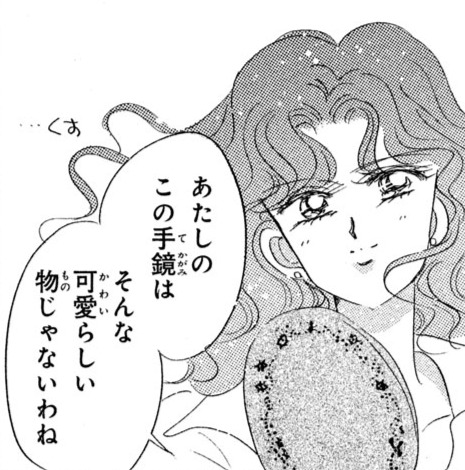
Seeing Chibiusa leaving Hotaru’s house, Haruka and Michiru stop over to pick her up. Michiru asks what the two were talking about, and Chibiusa explains that it was a conversation about amulets and their mysterious protective powers. She asks if Michiru has one. Michiru says her mirror may be protective, to which Chibiusa says it must be an amulet.
- みちる:
- 「あたしのこの手鏡はそんな可愛らしい物じゃないわね」
- “This hand mirror of mine isn't something that cute.”
- Literal: “This hand mirror of mine isn't that sort of cute thing, is it?”
Key Points
- 手鏡 means a small mirror you hold in your hand, so here Michiru is talking about the specific mirror she carries.
- The line contrasts her mirror with the kind of cute protective charm Chibiusa has just been talking about.
- そんな points back to the previous idea, meaning “that sort of” or “that kind of”.
- 可愛らしい is a slightly softer, more refined way to say something is cute or charming.
- So そんな可愛らしい物 means “something as cute as that” rather than just a general “cute thing”.
- じゃない is the casual spoken form of ではない.
- Here it means her mirror is not the kind of cute amulet-like object Chibiusa has in mind.
- あたし is a feminine casual way of saying “I”.
- わね softens the statement and gives it an elegant, lightly reflective tone rather than making it sound blunt.
Vocabulary
| Word | English | Meaning |
|---|---|---|
| あたし | I | あたし means “I” or “me”. It is a casual, feminine form of 私. |
| この | This | この means “this” or “these” and comes directly before a noun. It points to something near the speaker or something the speaker is referring to in the conversation. |
| 手鏡 | Hand mirror | 手鏡 means a small handheld mirror. |
| そんな | Like that | そんな describes something like the thing just mentioned. Said alone, it shows shock or denial: “no way!” |
| 可愛らしい | Lovely | 可愛らしい describes a person or thing that looks sweet in a small, charming way. It is a little more formal than 可愛い. |
| 物 | Thing | 物 is a physical thing or object. |
See Also
- Kanji: Reflection and optics with 鏡
- Grammar: Marking the topic with は and も
- Grammar: Negation with 〜ない
- Grammar: The copula だ
- Grammar: Seeking agreement with ね
- Grammar: Compound voicing with 連濁
- Kanji: Hands and skill with 手
- Kanji: Things and kinds with 物