Re-learning how to swim with 〜直す
Grammar Explanation: Doing better with 〜直す
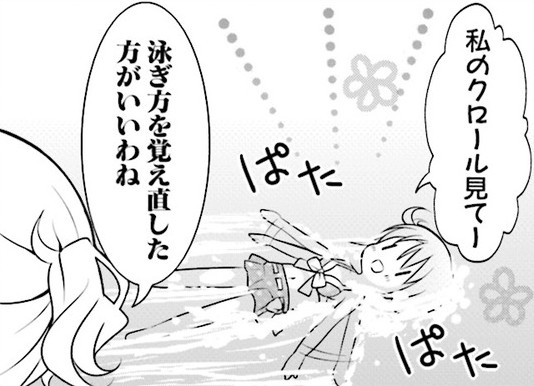
Cocoa and her friends visit an indoor hot spring. Rize admits she doesn’t know how to swim.
- ココア:
- 「私のクロール見てー」
- “Look at my front crawl!”
- シャロ:
- 「泳ぎ方を覚え直した方がいいわね」
- “You'd better learn how to swim over again.”
- Literal: “It would be better to relearn the way to swim.”
Key Points
- Syaro says Cocoa needs to replace her mistaken swimming method, not repeat the same practice unchanged.
- 覚える becomes 覚え, then 直す creates the corrective repetition verb.
- 覚え直した方がいい means Cocoa would be better off relearning how to swim.
- A sentence ending in the て-form can leave ください unstated. The long てー stretches Cocoa’s call for attention.
Vocabulary
| Word | English | Meaning |
|---|---|---|
| 私 | I | 私 means “I” or “me”. It is the standard first-person pronoun in polite speech and is also common in casual speech among women. |
| クロール | Front crawl | クロール is the front crawl, a swimming stroke. |
| 見る | To see | 見る is to see, look at, or watch something. It also means to check or judge something, or to look after someone, as in 面倒を見る. |
| 泳ぎ方 | Swimming style | 泳ぎ方 is the way someone swims, or a swimming stroke. |
| 覚える | To remember | 覚える is to learn and keep something in memory. |
| 直す | To fix | 直す is to repair or correct something. After a verb stem, it means to redo the action. |
| 方 | Side | 方 is a direction or side. In comparisons, 〜方がいい means “it’s better to”. Read かた, it is a polite word for a person. |
| いい | Good | いい describes something good, nice, or fine. It can also mean “okay” or “that’s enough”. Its other forms come from よい, as in よくない and よかった. |
See Also
- Grammar: Doing better with 〜直す
- Grammar: Giving advice with 〜た+方がいい
- Grammar: Connecting actions with 〜て・〜で
- Grammar: More than with 〜方が and 〜より
- Kanji: Privacy and self with 私
- Kanji: Seeing and viewpoints with 見