Reading a book to distract from waiting for a text message with 気を紛らす
Idiom Explanation: Distracting oneself with 気を紛らす
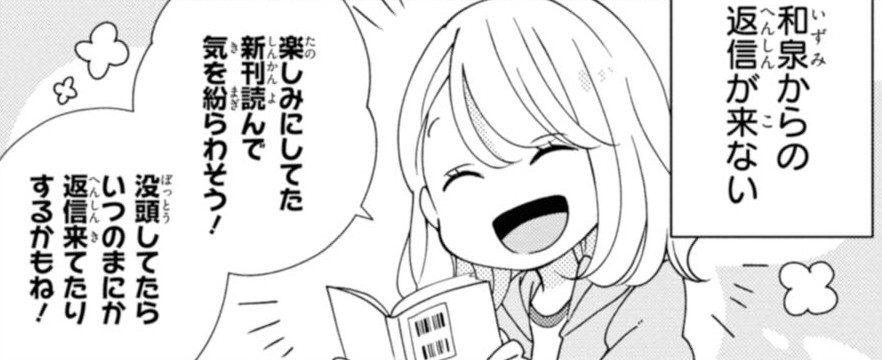
Akari is expecting a text message from Izumi. Unknown to her, Izumi’s response was getting too long, so he switched to his computer to write up an e-mail instead.
- Narration:
- 「和泉からの返信が来ない」
- “I haven't received a reply from Izumi.”
- あかり:
- 「楽しみにしてた新刊読んで気を紛らわそう!」
- “I'll distract myself by reading the new book I've been looking forward to!”
- Literal: “I'll read the new book I was looking forward to and divert my feelings!”
- 「没頭してたらいつのまにか返信来てたりするかもね!」
- “Maybe if I get really absorbed in it, the reply will show up before I know it!”
Key Points
1気を紛らわそう = “I’ll distract myself”
- 気を紛らす is an idiom meaning “to divert your feelings/attention to ease anxiety or impatience”.
2読んで気を紛らわそう = two actions chained in casual speech
- The core structure is 新刊(を)読んで、気を紛らわそう.
- The particle を after 新刊 is omitted (very normal in casual speech).
- The て-form (読んで) links “read it” to “and (by doing that) distract myself”.
3楽しみにしてた = 楽しみにしていた (spoken contraction)
- 〜てた is the casual contraction of 〜ていた.
- 楽しみにしてた新刊 means “the new volume I’d been looking forward to” (enough context that “new volume” implies “of the series”).
4返信が来ない / 返信来てたりするかも = “reply hasn’t come” / “might have come”
- 和泉からの返信が来ない: literally “a reply from Izumi isn’t coming” or “I haven’t gotten a reply from Izumi”.
- 来てたりするかも is casual speculation (“it might have come / might be there”).
Vocabulary
返信 (Reply)
返信 means a reply to a message, email, or letter.
来る (To come)
来る means to come or move toward the speaker or the place being discussed.
没頭 (Absorption)
没頭 means becoming completely absorbed in an activity, often losing track of time.
See Also
- Idiom: Distracting oneself with 気を紛らす
- Future entry: Past tense with 〜た・〜だ
- Grammar: Negation with 〜ない
- Kanji: Sinking and disappearing with 没
ブラザー・トラップ © its respective creators. It is used here for educational commentary.