Receiving a held image with 〜れる
Grammar Explanation: Receptive verbs with 〜れる
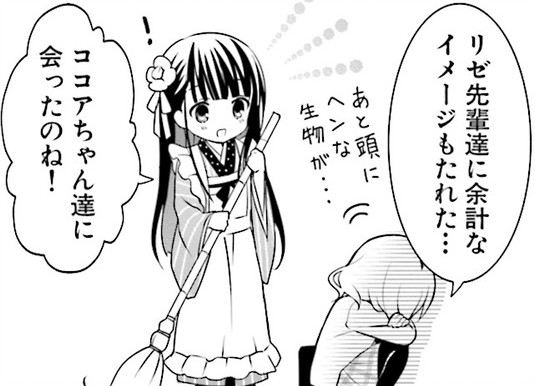
Syaro returns home after seeing Rize at the store.
- シャロ:
- 「リゼ先輩に余計なイメージもたれた…」
- “A wrong impression of me has become held by Rize-senpai...”
- Literal: “An unnecessary image of me was received as held by Rize-senpai...”
- 「あと頭にへんな生物が…」
- “And there was a strange creature on her head...”
- 千夜:
- 「ココアちゃん達に会ったのね!」
- “So you met Cocoa and the others!”
Key Points
- The literal image of something “being held” becomes “Rize has an impression of me” in this context.
- In the receptive sentence, Syaro receives the unwanted judgment and Rize is the person who forms it.
- The godan verb uses 持た plus れる. The line uses the past form もたれた because Syaro believes the impression has already formed.
- The final が marks the strange creature as the subject, but Syaro trails off before stating what it was doing on Cocoa’s head.
- Chiya uses explanatory の and final ね as she works out that Syaro met Cocoa and the others.
Vocabulary
| Word | English | Meaning |
|---|---|---|
| 先輩 | Senior | 先輩 is a senior member of the same school, workplace, or group, usually someone who joined earlier or has more experience. |
| 余計 | Excessive | 余計 describes something more than needed, or unnecessary and unwanted. |
| イメージ | Image | イメージ is a picture or impression of someone or something that forms in your mind. |
| もつ | To hold | もつ is to hold or carry something, or to have it. It also means to hold an impression or image of someone. It is also written 持つ. |
| あと | After | あと is the time after something, the space behind something, or what remains. At the start of a sentence, it adds one more point, like “also”. It is also written 後. |
| 頭 | Head | 頭 means the head of the body. It can also mean the top or beginning of something. |
| へん | Strange | へん describes something odd, unusual, or suspicious. It is also written 変. |
| 生物 | Living thing | 生物 is any living creature. Read なまもの, it means raw food. |
| 会う | To meet | 会う means to meet or see someone in person. |
See Also
- Grammar: Receptive verbs with 〜れる
- Grammar: Past tense with 〜た・〜だ
- Grammar: Reasoning with 〜のだ
- Grammar: Seeking agreement with ね
- Kanji: Counting and planning with 計
- Kanji: Meeting and joining with 会
- Kanji: Things and kinds with 物