Receiving a taking-away with 〜れる
Grammar Explanation: Receptive verbs with 〜れる
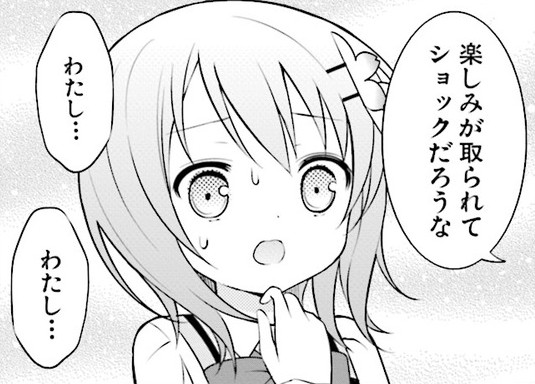
Cocoa isn’t certain why Chino is upset, until Rize explains what it meant when Cocoa completed the puzzle Chino had been working on a little each day.
- リゼ:
- 「楽しみが取られてショックだろうな」
- “She must be shocked that she had her fun taken away.”
- Literal: “Her fun was received as taken away, so she must be shocked.”
- ココア:
- 「わたし… わたし…」
- “I... I...”
Key Points
1楽しみが取られて describes a pleasure being taken away
- 楽しみが marks Chino’s daily enjoyment as the thing Cocoa took from her by finishing the puzzle.
2て links a cause to its effect
- 取られて links the loss of Chino’s enjoyment to her shock. The receptive verb takes the て-form (取る becomes 取られる), and the emotional result follows.
3ショックだろうな is Rize’s inference
- だろう marks a supposition and な voices Rize’s reflection that Chino must be upset.
Vocabulary
| Word | English | Meaning |
|---|---|---|
| 楽しみ | Something to look forward to | 楽しみ is something you enjoy or look forward to. 楽しみにする means to look forward to it. |
| 取る | To take | 取る means to take or obtain something. Its exact sense depends on what is being taken. |
| ショック | Shock | ショック is the feeling of being shocked or upset by something unexpected. |
| わたし | I | わたし is the most common word for “I”, used by anyone in polite speech and by women in casual speech. It is also written 私. |
See Also
- Grammar: Receptive verbs with 〜れる
- Grammar: Presuming with 〜だろう and 〜でしょう
- Grammar: Connecting actions with 〜て・〜で
ご注文はうさぎですか? © its respective creators. It is used here for educational commentary.