Receiving a throwing with 〜れる
Grammar Explanation: Receptive verbs with 〜れる
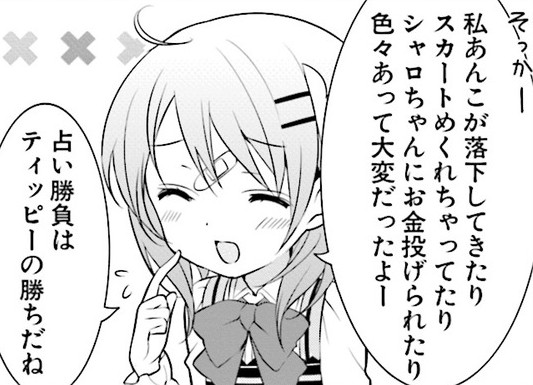
After learning the fortunes she told didn’t come true for Chino and Rize, Cocoa lists the bad fortune she ran into.
- ココア:
- 「そっかー」
- “I see.”
- 「私あんこが落下してきたりスカートめくれちゃってたりシャロちゃんにお金投げられたり色々あって大変だったよー」
- “All sorts of things happened to me, like Anko falling on me, my skirt flipping up, and having Syaro-chan throw money at me, so it was rough.”
- Literal: “I had various things happen, like Anko falling on me, my skirt flipping up, and receiving money thrown by Syaro-chan, so it was rough.”
- 「占い勝負はティッピーの勝ちだね」
- “Then Tippy wins the fortune-telling contest.”
投げる’s negative stem is 投げ. Append られる for 投げられる.
Key Points
- The line gives examples rather than a complete list. 投げられたり presents Cocoa as affected by Syaro throwing money.
- だ identifies the outcome as Tippy’s win, and ね seeks agreement with that conclusion.
- ちゃん is an affectionate, informal suffix attached to names, used mainly for children, close friends, and family members.
Vocabulary
| Word | English | Meaning |
|---|---|---|
| 私 | I | 私 means “I” or “me”. It is the standard first-person pronoun in polite speech and is also common in casual speech among women. |
| 落下 | Fall | 落下 is something falling from a higher place to a lower one. |
| スカート | Skirt | スカート is a skirt. |
| めくれる | To flip up | めくれる is for a covering, such as a skirt or a page, to turn up or roll back. It is also written 捲れる. |
| お金 | Money | お金 is money in general, such as coins, bills, and funds. |
| 投げる | To throw | 投げる is to throw something. It also means to give something up. |
| 大変 | Serious | 大変 describes something serious or hard to deal with. As an adverb, it means “very”. |
| 占い | Fortune telling | 占い is predicting the future or someone’s fate, by cards, stars, coffee grounds, and other methods. |
| 勝負 | Match | 勝負 means a contest, match, or showdown that decides a winner and loser. |
| 勝ち | Win | 勝ち is a win or victory. |
See Also
- Grammar: Receptive verbs with 〜れる
- Grammar: Past tense with 〜た・〜だ
- Grammar: Connecting actions with 〜て・〜で
- Grammar: Doing completely or ending up doing with 〜てしまう and 〜ちゃう
- Grammar: Seeking agreement with ね
- Grammar: The copula だ
- Grammar: Informing with よ
- Grammar: Consonant doubling with 促音
- Grammar: Listing example actions with 〜たり〜たりする
- Grammar: Coming and going with 〜てくる and 〜ていく
- Kanji: Below and lowering with 下
- Kanji: Privacy and self with 私