Receiving an embrace with 〜れる
Grammar Explanation: Receptive verbs with 〜れる
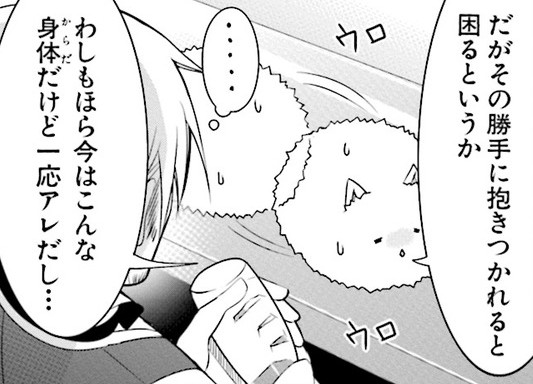
Tippy is glad that Cocoa is around to be friends with Chino, but it’s a problem for him.
- ティッピー:
- 「だがその勝手に抱きつかれると困るというか」
- “But being hugged like that without warning is a bit troubling.”
- Literal: “But when I receive clinging hugs selfishly like that, it is troubling, or rather...”
- 「わしもほら今はこんな身体だけど一応アレだし…」
- “I may have a body like this now, but I'm still, you know...”
Key Points
- Cocoa is the omitted performer, while Tippy describes the unwanted hugs from his own affected position.
- The godan verb changes to 抱きつか before れる.
- 勝手に says Cocoa acts without permission. というか trails off as Tippy searches for a less direct way to call it troubling.
- Tippy hints that he is still a man despite his current body. し leaves the embarrassing explanation unfinished.
Vocabulary
| Word | English | Meaning |
|---|---|---|
| その | That | その points to something near the listener or to something just mentioned. Said alone, it fills a pause, like “um”. |
| 勝手に | Without permission | 勝手に describes doing something on one’s own, without asking or being asked. |
| 抱きつく | To hug | 抱きつく is to throw one’s arms around someone and cling to them. |
| 困る | To be troubled | 困る is to be in a difficult situation without knowing what to do. |
| わし | I | わし is a word for “I” used mostly by old men. |
| 今 | Now | 今 is the present moment, or these days. |
| こんな | Like this | こんな describes something like the thing in front of the speaker or the thing just mentioned. |
| 身体 | Body | 身体 is the human body. It is more formal than 体. |
| 一応 | For the time being | 一応 means for now, tentatively, or more or less. It suggests that something is sufficient, though not necessarily ideal. |
| アレ | That | アレ is a katakana spelling of あれ, “that”. It often hints at something the speaker would rather not say outright. |
See Also
- Grammar: Receptive verbs with 〜れる
- Grammar: Contrasting with 〜が〜
- Grammar: Natural result with 〜と
- Kanji: Body and substance with 体
- Kanji: Hands and skill with 手
- Kanji: Now and the present with 今