Receiving an overtaking with 〜れる
Grammar Explanation: Receptive verbs with 〜れる
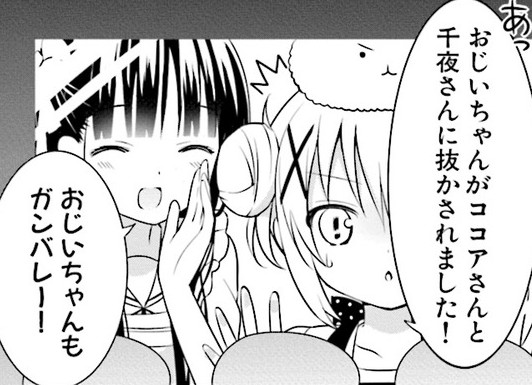
Chino watches her “grandpa” bread bake alongside Cocoa’s and Chiya’s breads.
- チノ:
- 「おじいちゃんがココアさんと千夜さんに抜かされました!」
- “Grandpa got passed by Cocoa-san and Chiya-san!”
- Literal: “Grandpa received being passed by Cocoa-san and Chiya-san!”
- 千夜:
- 「おじいちゃんもガンバレー!」
- “You can do it too, Grandpa!”
抜かす’s negative stem is 抜かさ. Append れる for 抜かされる.
Key Points
1抜かされました presents Grandpa as the one overtaken
- Cocoa and Chiya perform the action, marked by に, while Grandpa receives it.
2ガンバレー stretches a plain command
- 頑張れ is the imperative of 頑張る. The long vowel turns it into a cheer.
- さん is an honorific suffix attached to a person’s name to show respect and social distance, roughly equivalent to “Mr.”, “Ms.”, or “Mrs.” in English, though it’s used far more broadly and doesn’t specify gender or marital status.
Vocabulary
| Word | English | Meaning |
|---|---|---|
| おじいちゃん | Grandpa | おじいちゃん is a familiar word for one’s grandfather. People also use it for any elderly man. |
| 抜かす | To pass | 抜かす is to overtake someone. It also means to skip or leave something out. |
| がんばる | To do one's best | がんばる is to keep working hard or keep going through difficulty. It is also written 頑張る. |
See Also
- Grammar: Receptive verbs with 〜れる
- Grammar: Past tense with 〜た・〜だ
- Grammar: The plain imperative
- Grammar: Marking the topic with は and も
ご注文はうさぎですか? © its respective creators. It is used here for educational commentary.