Receiving involvement with 〜れる
Grammar Explanation: Receptive verbs with 〜れる
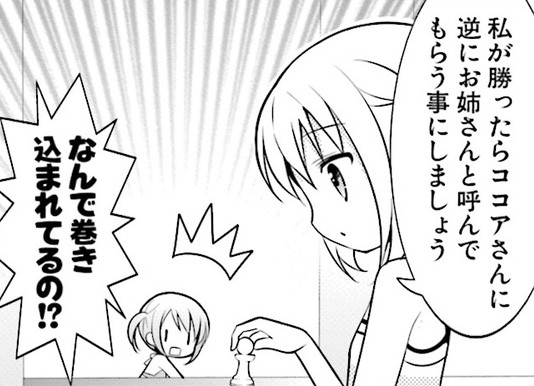
Chiya and Chino play chess at an indoor hot spring.
- チノ:
- 「私が勝ったらココアさんに逆にお姉さんと呼んでもらう事にしましょう」
- “If I win, I'll have Cocoa call me her big sister instead.”
- ココア:
- 「なんで巻き込まれてるの!?」
- “Why am I getting dragged into this!?”
- Literal: “Why am I receiving being dragged in!?”
Key Points
- Cocoa receives the effect of a bet made by other people, even though she did not agree to take part.
- The godan verb uses 巻き込ま plus れる. 巻き込まれてる contracts the continuing form 巻き込まれている.
- Cocoa omits “I” and “this bet” because both are clear from the scene. The final の gives her protest an explanatory question tone.
- The bet only applies if Chino wins, and ことにしましょう proposes adopting that result as the rule.
- と marks the name Cocoa would use, while 〜てもらう frames Chino as receiving that action from her.
Vocabulary
| Word | English | Meaning |
|---|---|---|
| 私 | I | 私 means “I” or “me”. It is the standard first-person pronoun in polite speech and is also common in casual speech among women. |
| 勝つ | To win | 勝つ is to win against an opponent or in a contest. |
| 逆 | Reverse | 逆 is the opposite or reverse of something. 逆に means “instead” or “on the contrary”. |
| お姉さん | Big sister | お姉さん is a polite word for one’s older sister. People also use it to address or refer to a young woman. |
| 呼ぶ | To call | 呼ぶ is to call out to someone, call someone over, or call something by a name. |
| 事 | Thing | 事 is an abstract thing, matter, or fact. It also turns a verb phrase into a noun, as in 見た事がある. It is often written こと. |
| する | To do | する is to do or perform something. It also turns many nouns into verbs, as in 勉強する. |
| なんで | Why | なんで asks for the reason something happens. It is more casual than どうして. |
| 巻き込む | To drag into | 巻き込む is to pull someone into trouble or a situation they have nothing to do with. |
See Also
- Grammar: Receptive verbs with 〜れる
- Grammar: If and when with 〜たら
- Grammar: Having someone do something with 〜てもらう
- Grammar: Quoting and reporting with と and って
- Grammar: Volitional with 〜う・〜よう
- Grammar: Reasoning with 〜のだ
- Grammar: Deciding to with 〜ことにする
- Kanji: Matters and events with 事
- Kanji: Privacy and self with 私