Receiving praise with 〜れる
Grammar Explanation: Receptive verbs with 〜れる
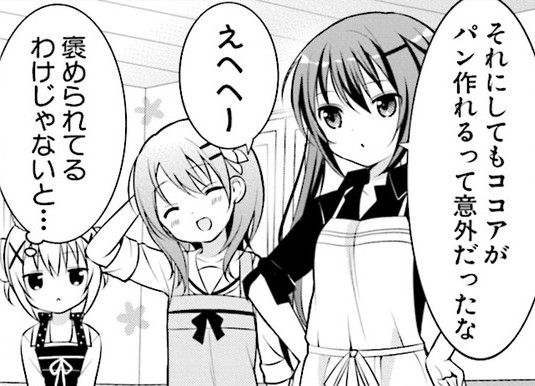
Cocoa prepares to teach Chiya, Chino, and Rize how to bake bread.
- リゼ:
- 「それにしてもココアがパン作れるって意外だったな」
- “Still, I didn't expect you to know how to bake bread, Cocoa.”
- ココア:
- 「えへへー」
- “Hee hee!”
- チノ:
- 「褒められてるわけじゃないと…」
- “It's not like you're being praised...”
- Literal: “It is not that you're receiving praise...”
Key Points
1褒められてる means being praised
- Cocoa takes Rize’s surprise as praise.
2褒める becomes 褒められる
- The ichidan verb drops る and adds られる. 褒められてる contracts 褒められている.
3わけじゃない rejects Cocoa’s conclusion
- 〜わけじゃない means “it is not the case that…” Chino thinks Rize’s comment should not count as praise.
4パン作れるって意外だった makes Cocoa’s ability the topic
- 作れる is the potential form, “can make”. って puts that whole fact forward as what surprised Rize.
Vocabulary
| Word | English | Meaning |
|---|---|---|
| パン | Bread | パン is bread, including rolls and pastries. |
| 作る | To make | 作る means to create or prepare something. |
| 意外 | Unexpected | 意外 describes something surprising, not what one expected. |
| 褒める | To praise | 褒める is to say good things about someone or what they did. |
See Also
- Grammar: Receptive verbs with 〜れる
- Grammar: Able to do with 〜れる・〜られる
- Grammar: Past tense with 〜た・〜だ
- Kanji: Making and creating things with 作
- Kanji: Thought and intention with 意
ご注文はうさぎですか? © its respective creators. It is used here for educational commentary.