Receiving saying with 〜れる
Grammar Explanation: Receptive verbs with 〜れる
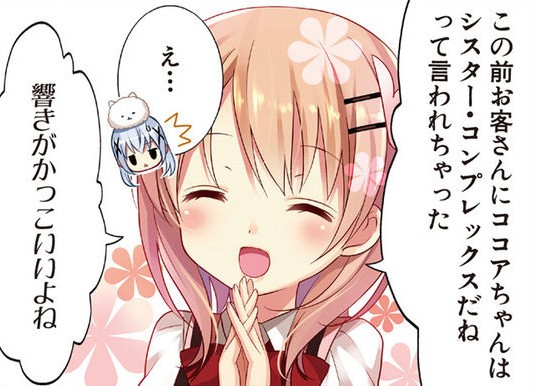
Cocoa takes a brief break from work to tell Chino something good that just happened.
- ココア:
- 「この前お客さんにココアちゃんはシスター・コンプレックスだねって言われちゃった」
- “Earlier, it was said by a customer that I have a sister complex.”
- Literal: “The other day, I ended up receiving it said by a customer, 'Cocoa-chan, you have a sister complex.'”
- チノ:
- 「え…」
- “Ah...”
- ココア:
- 「響きがかっこいいよね」
- “It sounds cool, doesn't it?”
Key Points
1言われちゃった = “I got told”
- The receiver of the saying is Cocoa, even though the sentence does not say 私が.
- Here お客さんに marks who said it: a customer said this to Cocoa.
2Receptive 〜れる with 言う
- 言う becomes 言われる in the receptive form.
- In full, the core idea is お客さんに 言われた: “I was told by a customer” or “a customer told me”.
3って marks the quoted comment
- Everything before って is what the customer said: ココアちゃんはシスター・コンプレックスだね.
- The は in ココアちゃんは belongs inside that quote; it is not marking the subject of 言われちゃった.
4ちゃった is casual てしまった
- 言われちゃった is the casual past form of 言われてしまった.
- ちゃった often adds a sense of “ended up”, but Cocoa is happy here, not upset.
- ちゃん is an affectionate, informal suffix attached to names, used mainly for children, close friends, and family members.
Vocabulary
| Word | English | Meaning |
|---|---|---|
| この前 | The other day | この前 is a recent time in the past, or the most recent one of something. |
| お客さん | Customer | お客さん is a polite word for a customer, guest, or visitor. |
| シスター | Sister | シスター is a sister. It also means a nun. |
| コンプレックス | Complex | コンプレックス is a feeling of inferiority about something. シスター・コンプレックス is an excessive attachment to one’s sister. |
| 言う | To say | 言う means to say or tell. It can also mean to call something by a particular name. |
| 響き | Ring | 響き is the sound or ring of something, such as how a word sounds. |
| かっこいい | Cool | かっこいい describes someone or something that looks stylish, attractive, or impressive. |
See Also
- Grammar: Receptive verbs with 〜れる
- Grammar: Past tense with 〜た・〜だ
- Grammar: Doing completely or ending up doing with 〜てしまう and 〜ちゃう
- Grammar: Marking the subject with が
- Grammar: Marking the topic with は and も
- Grammar: Quoting and reporting with と and って
- Grammar: Seeking agreement with ね
ご注文はうさぎですか? © its respective creators. It is used here for educational commentary.