Reelected class representative with 当選
Kanji Explanation: Choosing and selection with 選
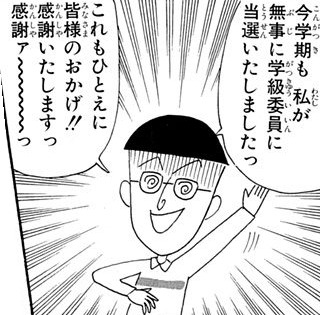
The second term has just begun at Maruko’s school, and her class has held its vote for class representative. Maruo held the post last term and loves the job.
- 丸尾くん:
- 「今学期も 私が 無事に学級委員に 当選いたしましたっ」
- “This term, too, I have been duly elected class representative!”
- 「これもひとえに 皆様のおかげ!! 感謝いたしますっ 感謝ァ〜〜〜っ」
- “I owe it all to you, everyone!! I thank you! Thaaank youuu!”
Key Points
- 当選 means winning an election. 学級委員に当選する is being elected class representative, with に marking the post.
- The same word covers winning a prize draw or a contest entry. The post named here shows that Maruo means the class vote.
- いたしました is the humble form of しました, so 当選いたしました is a deferential “I have been elected”. 感謝いたします is “I thank you” in the same style.
- Third graders don’t talk like this. Maruo is copying a politician’s victory speech, which is the joke.
- も in 今学期も means “this term too”. He held the post last term.
- 無事に means “safely” or “without trouble”. Here it is closer to “duly”. The election went as he hoped.
- 〜のおかげ means “thanks to 〜”. ひとえに strengthens it to “entirely”. The whole phrase, “it is entirely thanks to all of you”, is a stock line from acceptance speeches.
- 皆様 is a polite “everyone”, one step above 皆さん.
- The small っ in いたしましたっ and いたしますっ cuts each sentence off sharply, showing Maruo’s excitement. The stretched 感謝ァ〜〜〜っ draws out his thanks even further.
Vocabulary
| Word | English | Meaning |
|---|---|---|
| 今 | Now | 今 is the present moment, or these days. |
| 学期 | School term | 学期 is a school term. Japanese schools usually split the year into three, so 二学期 is the second term, which starts after summer vacation. |
| 私 | I | 私 means “I” or “me”. It is the standard first-person pronoun in polite speech and is also common in casual speech among women. |
| 無事 | Safety | 無事 describes being safe and unhurt, with nothing going wrong. |
| 学級委員 | Class representative | 学級委員 is a student chosen to represent a class and lead its meetings. The one in charge is the 学級委員長. |
| 当選 | Election victory | 当選 is winning an election, or being picked as a winner in a lottery or prize drawing. |
| いたす | To do (humble) | いたす is the humble form of する. Speakers use it for their own actions to show respect to the listener, as in 感謝いたします, “I thank you”. |
| これ | This | これ points to something close to the speaker, or to the thing just mentioned. |
| ひとえに | Entirely | ひとえに means entirely or solely. It often comes before 〜のおかげ in formal thanks, as in ひとえに皆様のおかげです. |
| 皆様 | Everyone | 皆様 is a respectful word for everyone present or everyone addressed. Announcements and letters use it where speech would say 皆さん. |
| おかげ | Thanks to | おかげ is the help or influence someone or something gives. 〜のおかげ means “thanks to”. It is also written お陰. |
| 感謝 | Gratitude | 感謝 means gratitude or thanks for someone’s kindness or help. |
See Also
- Kanji: Choosing and selection with 選
- Grammar: Blame and credit with 〜せいで and 〜おかげで
- Grammar: Polite style with です and ます
- Grammar: Marking the topic with は and も
- Kanji: Absence and nothingness with 無
- Kanji: Forms and appearances with 様
- Kanji: Learning and schooling with 学
- Kanji: Matching and appropriateness with 当
- Kanji: Matters and events with 事
- Kanji: Members and personnel with 員
- Kanji: Now and the present with 今
- Kanji: Privacy and self with 私