Reeling in the master of the lake with 釣りあげる
Kanji Explanation: Fishing and baiting with 釣
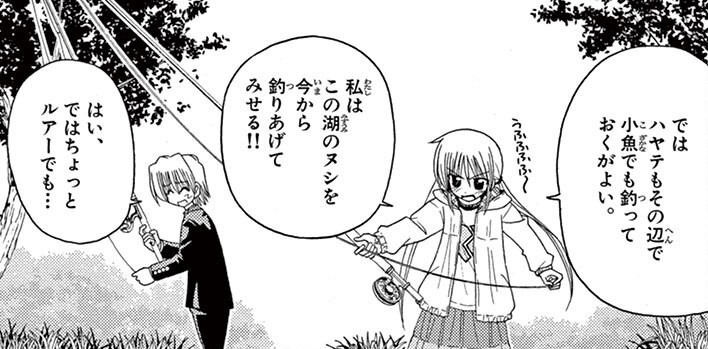
Inspired by a fishing manga, Nagi has dragged Hayate to the lake on the Sanzenin estate. She insists on fly fishing, though she has never tried it, because the hero of her manga does it. After looking over the equipment, she declares that she understands how it works.
- ナギ:
- 「ではハヤテもその辺で小魚でも釣っておくがよい。」
- “Then you can go catch some little fish over there, Hayate.”
- 「私はこの湖のヌシを今から釣りあげてみせる!!」
- “I'm going to reel in the master of this lake, starting right now!”
- ハヤテ:
- 「はい、ではちょっとルアーでも…」
- “Okay, then I'll try a lure or something...”
Key Points
- 釣りあげる joins 釣る, “to fish”, and あげる, “to raise”. It means hooking a fish and pulling it up out of the water, that is, landing it.
- The dictionary form is usually written 釣り上げる. Here the dialogue writes the second half in kana.
- Compare 釣っておく in Nagi’s first line. Plain 釣る is the general verb, and 釣りあげる puts the focus on the moment the catch comes out of the water.
- ヌシ (also written 主) is the old giant fish said to rule a lake or river. Fishing stories treat catching it as the ultimate goal.
- 〜てみせる means “I’ll do it, just watch”. It turns a plan into a challenge. Nagi has never fly fished, so the boast says more about her confidence than her skill.
- 釣っておくがよい is an old-fashioned, lordly way to say “you may go fish”. Nagi likes talking down to Hayate like this.
- でも in 小魚でも and ルアーでも offers an example without committing to it: “small fish or something”, “a lure or something”.
Vocabulary
| Word | English | Meaning |
|---|---|---|
| その辺 | Around there | その辺 points to the area near the listener or near something just mentioned, without naming an exact spot. |
| 小魚 | Small fish | 小魚 are little fish, as opposed to a big prize catch. |
| 釣る | To fish | 釣る is to catch a fish with a hook and line. It also means to lure a person with something they want, as in 餌で釣る. |
| よい | Good | よい describes something good, nice, or proper. It is the more formal form of いい, and its other forms, like よく and よかった, are used in everyday speech. It is also written 良い. |
| 私 | I | 私 means “I” or “me”. It is the standard first-person pronoun in polite speech and is also common in casual speech among women. |
| この | This | この means “this” or “these” and comes directly before a noun. It points to something near the speaker or something the speaker is referring to in the conversation. |
| ヌシ | Lord of a lake | ヌシ is the old, huge fish or creature said to rule a lake or river, as if it were its guardian spirit. It is also written 主. |
| 今から | From now | 今から means starting right now. |
| 釣りあげる | To reel in | 釣りあげる is to pull a hooked fish out of the water and land it. It is also written 釣り上げる. |
| みせる | To show | みせる is the kana spelling of 見せる, to show. After a て-form it means doing something to prove you can: やってみせる, “I’ll do it, just watch.” |
| ちょっと | A little | ちょっと describes a small amount or a short time. It also softens a refusal, or calls someone’s attention, like “hey”. |
| ルアー | Lure | A ルアー is an artificial bait made to look like a small fish or insect. Anglers cast it and reel it in to tempt fish. |
See Also
- Kanji: Fishing and baiting with 釣
- Grammar: Offering an example with 〜でも
- Grammar: Doing in advance with 〜ておく
- Kanji: Now and the present with 今
- Kanji: Privacy and self with 私