Reeling it in before it escapes with 釣り上げる
Kanji Explanation: Fishing and baiting with 釣
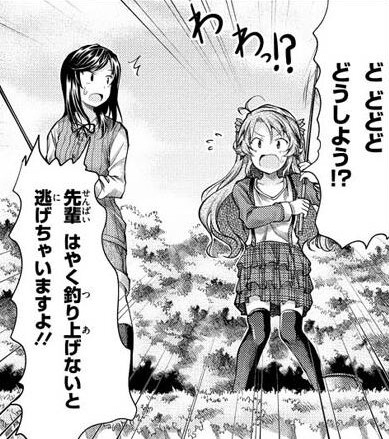
Natsumi’s mother has offered her pocket money to catch some creatures for a pond, so Natsumi has dragged everyone out to go fishing. As Komari waits with her line in the water, her rod suddenly jerks, and she cries that she might have hooked a fish.
- 小鞠:
- 「わ わっ!?」
- “Wh-whoa!?”
- 「ど どどど どうしよう!?」
- “Wh-wh-what do I do!?”
- 蛍:
- 「先輩 はやく釣り上げないと逃げちゃいますよ!!」
- “Senpai, reel it in fast or it'll get away!”
Key Points
- 釣り上げる joins 釣る and 上げる. Where 釣る is catching in general, 釣り上げる is the moment you pull the fish up and out of the water.
- The same verb also means to push a price up, but with a bent rod in Komari’s hands, only the fishing sense fits.
- 〜ないと + a bad result means “if you don’t…, then…”. はやく釣り上げないと逃げちゃう is “if you don’t land it fast, it’ll get away”.
- On its own, a sentence that ends in 〜ないと often means “have to”. Here Hotaru spells out the consequence.
- 〜ちゃう is the casual form of 〜てしまう. 逃げちゃう carries the sense of something you’d regret: the fish getting away for good.
- Hotaru adds ます because she’s talking to an older student, and よ to press the warning home.
- Hotaru is in fifth grade but calls Komari, a second-year in middle school, 先輩. Japanese students often call older schoolmates 先輩 instead of using their names.
Vocabulary
| Word | English | Meaning |
|---|---|---|
| どう | How | どう asks about the way or state of something: “how” or “how about”. It also appears in どうしよう, “what should I do?” |
| する | To do | する is to do or perform something. It also turns many nouns into verbs, as in 勉強する. |
| 先輩 | Senior | 先輩 is a senior member of the same school, workplace, or group, usually someone who joined earlier or has more experience. |
| はやい | Fast | はやい describes something quick, or something that happens early. It is also written 早い or 速い. |
| 釣り上げる | To reel in | 釣り上げる is to pull a hooked fish out of the water and land it. It can also mean to drive a price up. |
| 逃げる | To run away | 逃げる is to escape or get away from someone or something, like a fish slipping off the hook or a person fleeing danger. |
| しまう | To put away | しまう is to put something back where it belongs. After a て-form verb, it shows an action is completely done, often with regret: “end up doing”. |
See Also
- Kanji: Fishing and baiting with 釣
- Grammar: Natural result with 〜と
- Grammar: Doing completely or ending up doing with 〜てしまう and 〜ちゃう
- Grammar: Polite style with です and ます
- Grammar: Informing with よ