Resolving the case with 解決
Kanji Explanation: Separating and understanding with 解
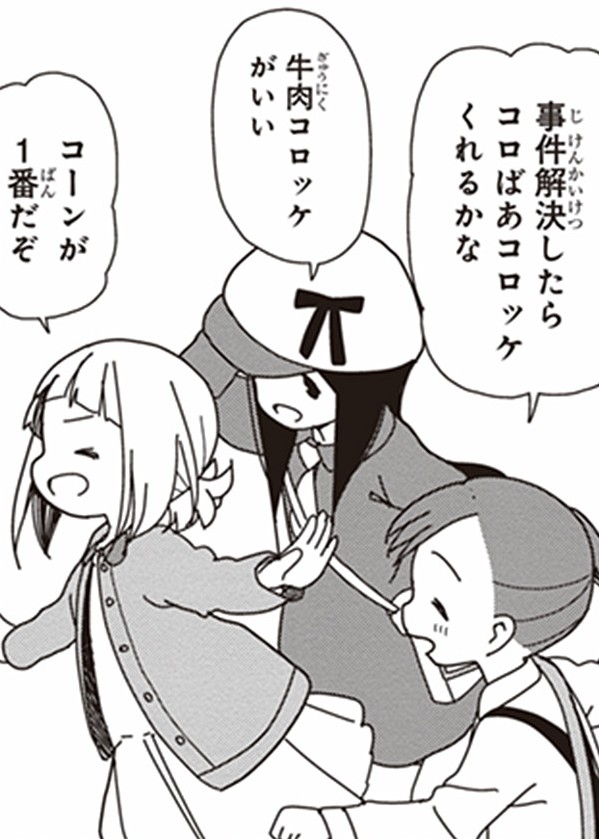
Kotoha brings news that the old woman who runs the croquette shop has a case for Colors. The trio heads out to the shop to get the details.
- 結衣:
- 「事件解決したらコロばあコロッケくれるかな」
- “If we resolve the case, will she give us croquettes?”
- Literal: “If the case gets resolved, I wonder if Koro-ba will give us croquettes.”
- 琴葉:
- 「牛肉コロッケがいい」
- “Beef croquette would be nice.”
- さっちゃん:
- 「コーンが1番だぞ」
- “Corn is best!”
解決 here means to bring resolution to the issue the old woman is troubled by.
Key Points
- 解 suggests untangling or solving, and 決 suggests deciding or settling.
- Together, 解決 is resolving a problem or case.
- 事件解決したら means “if we solve the case”.
- 事件 and 解決 sound detective-like.
- The replies about beef and corn croquettes make the mission playful.
Vocabulary
| Word | English | Meaning |
|---|---|---|
| 事件 | Incident | 事件 means an incident or event that attracts public attention. |
| 解決 | Resolution | 解決 means solving a problem, dispute, or difficult situation. |
| する | To do | する is to do or perform something. It also turns many nouns into verbs, as in 勉強する. |
| コロッケ | Croquette | コロッケ is a croquette, a deep-fried patty of mashed potato or meat coated in breadcrumbs. |
| くれる | To give | くれる is for someone to give something to the speaker or the speaker’s side. After a て-form verb, it means someone does something for the speaker. |
| 牛肉 | Beef | 牛肉 is the meat of cattle. |
| いい | Good | いい describes something good, nice, or fine. It can also mean “okay” or “that’s enough”. Its other forms come from よい, as in よくない and よかった. |
| コーン | Corn | コーン is corn. It can also mean an ice cream cone. |
See Also
- Kanji: Separating and understanding with 解
- Grammar: If and when with 〜たら
- Grammar: Wondering with かな
- Grammar: Rough declarations with ぞ and ぜ
- Grammar: Marking the subject with が
- Kanji: Matters and events with 事