Respected by the fishing folk with 漁民
Kanji Explanation: Fishing and catches with 漁
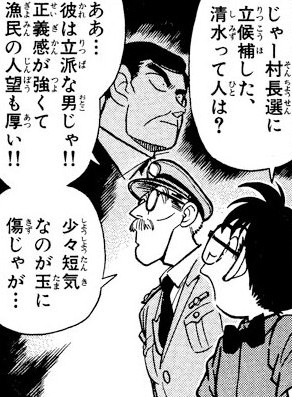
Conan is walking with the island’s elderly police officer to fetch a key from the police box. On the way, he asks about each person connected to the murders. The officer has just described Murasawa, who recently got engaged to the village head’s daughter, and Hirata, the village head’s secretary.
- コナン:
- 「じゃー村長選に立候補した、清水って人は?」
- “Then what about Shimizu, the guy who ran for village head?”
- おまわりさん:
- 「ああ…彼は立派な男じゃ!! 正義感が強くて漁民の人望も厚い!!」
- “Ah... He's a fine man!! He has a strong sense of justice, and the fishermen hold him in high regard!!”
- おまわりさん:
- 「少々短気なのが玉に傷じゃが…」
- “His one flaw is that he's a bit short-tempered, though...”
Key Points
- 漁 means fishing and 民 means people, so 漁民 is the people of a community who fish for a living. Read it ぎょ, as in 漁業 and 漁船.
- 漁師 names one person’s occupation. 漁民 treats fishermen as a group, which suits an island where they make up a large part of the voters.
- 人望 is the trust and admiration a person earns from the people around them. It is described as thick, 厚い, when there is a lot of it.
- The officer swaps が for も. Shimizu is a fine man with a strong sense of justice, and the fishermen also look up to him.
- 玉に傷 is a scratch on a gem. It names the one shortcoming in someone or something otherwise excellent. Dictionaries usually write it 玉に瑕, but 傷 is a common spelling, and it is the one this manga uses.
- 少々短気なのが turns “being a little short-tempered” into the subject with の. 短気 is a な-adjective, so it takes な before の.
- The officer uses じゃ for だ, a speech style manga often gives elderly characters. じゃが at the end equals だが, “though”, and softens his praise with a reservation.
- 正義感が強くて uses the て-form of 強い to link one good quality to the next.
Vocabulary
| Word | English | Meaning |
|---|---|---|
| 村長 | Village mayor | 村長 is the elected head of a village, or its chief in older and fantasy settings. |
| 選 | Election; selection | 選 is a selection or an election. After a noun it often stands for a whole election or contest, as in 村長選, a village mayor’s race. |
| 立候補 | Candidacy | 立候補 is putting oneself forward for election, from a seat in parliament to class representative. |
| 人 | Person | 人 is a person, or people in general. It also means other people. |
| ああ | Ah | ああ is a sound people make when something sinks in, when they sigh, or when they agree. As a reply, it is a casual “yes” or “right”. |
| 彼 | He | 彼 means he or him. In writing, it can retain the older sense of “that person”. |
| 立派 | Splendid | 立派 means splendid, impressive, or admirable. It can praise someone’s character or describe something as imposing and well made. |
| 男 | Man | 男 is a man or boy. |
| 正義感 | Sense of justice | 正義感 is a strong feeling for what is right and a desire to act on it. 正義感が強い describes someone with a strong sense of justice. |
| 強い | Strong | 強い describes superior strength or skill, physical or mental resilience, or an extreme degree or level of something. |
| 漁民 | Fishing folk | 漁民 are the people who make their living by fishing, usually thought of as a community or group. |
| 人望 | Popular esteem | 人望 is the trust and liking a person has earned from those around them. 人望がある describes someone others gladly follow. |
| 厚い | Thick | 厚い describes something with a lot of distance between its two surfaces, such as a thick book, slice, or pancake. It also describes warm, deep feelings, as in a kind welcome. |
| 少々 | A little | 少々 means a little or slightly. It is a more formal-sounding 少し, and also appears in polite requests to wait, as in 少々お待ちください. |
| 短気 | Short temper | 短気 means a quick temper or impatience. As a な-adjective, it describes someone who gets angry or loses patience easily. |
| 玉に傷 | The one flaw | 玉に傷 is the single shortcoming in someone or something otherwise excellent, like a scratch on a gem. Dictionaries usually write it 玉に瑕. |
See Also
- Kanji: Fishing and catches with 漁
- Grammar: Contrasting with 〜が〜
- Grammar: The copula だ
- Grammar: Connecting actions with 〜て・〜で
- Grammar: Marking the topic with は and も
- Kanji: Choosing and selection with 選
- Kanji: People and persons with 人
- Kanji: Shortness and brevity with 短
- Kanji: Strength and force with 強