Returning to nothingness with 無に還る
Vocabulary Explanation: Going home and giving back with かえる
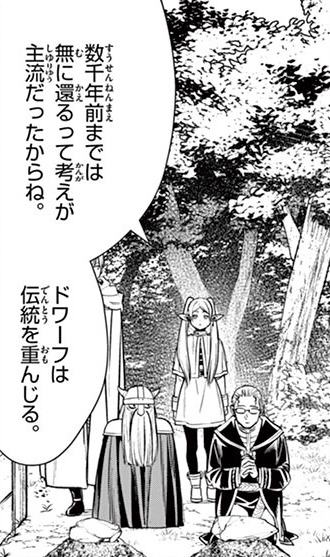
On their journey, the hero party stops at a cabin in the woods with graves beside it. Eisen says his village was attacked by demons long ago, and Heiter kneels at a grave to pray. Eisen tells him that when people die, they return to nothingness. Heiter answers that they go to heaven.
- フリーレン:
- 「数千年前までは無に還るって考えが主流だったからね。 ドワーフは伝統を重んじる。」
- “Up until a few thousand years ago, the main belief was that you return to nothingness. Dwarves hold on to tradition.”
Key Points
- 無 is “nothingness”, and に marks where something goes. 無に還る says that when someone dies, they go back to being nothing, with no soul and no afterlife.
- Eisen says it first on the previous page, 人は死んだら無に還る, “when people die, they return to nothingness”. Frieren picks up his phrase to explain where it comes from.
- Don’t confuse it with 無に帰す, “come to nothing”, which describes effort that goes to waste. That’s a different verb, 帰する, read き.
- The standard spelling of this かえる is 帰る, “go back”. The official kanji list gives 還 only its on reading カン, so 還る is an unofficial spelling.
- Manga reach for 還 when something returns to where everything began, such as soil or nothingness. 土に還る, “return to the earth”, is the most common example.
- The whole clause 無に還る is the content of 考え, “idea” or “belief”. って links it to the noun, as a casual stand-in for という. It works like English “the idea that…”.
- Frieren’s line, “the belief that you return to nothingness”, treats Eisen’s view as one belief among others.
- 主流だった is “was the mainstream”. から gives it as the reason for Eisen’s view, and ね softens it into a friendly explanation for Heiter.
- 数千年前までは is “up until a few thousand years ago”. The は sets that era against the present, when the idea is no longer the main one.
- 重んじる is “value” or “hold in high regard”. Dwarves value tradition, so Eisen still believes something most people dropped long ago.
Vocabulary
| Word | English | Meaning |
|---|---|---|
| 数千 | Several thousand | 数千 is several thousand, with the exact number left open. 数千年 is several thousand years. |
| 年 | Age | 年 is a year. Read とし, it also means a person’s age, as in この年になると, “at my age”. |
| 前 | Front | 前 is the front of something. It also means an earlier time, as in 三年前, “three years ago”. |
| 無 | Nothingness | 無 is nothingness, the state of there being nothing at all, as in 無に還る, “return to nothingness”. As a prefix, 無 or 無 means “without” or “un-“. |
| 還る | To return (to the source) | 還る is an unofficial spelling of 帰る, “go back”. Manga use it for going back to where something began, as in 土に還る, “return to the earth”. |
| 考え | Idea | 考え is a thought, idea, or opinion. |
| 主流 | Mainstream | 主流 is the mainstream, the main current of opinion, style, or practice that most people follow. It is also the main course of a river. |
| ドワーフ | Dwarf | ドワーフ is a dwarf, one of the short, sturdy folk of fantasy stories, often pictured as bearded miners and smiths. |
| 伝統 | Tradition | 伝統 is a way of doing things kept up over generations, such as a school’s customs or a craft. |
| 重んじる | To value | 重んじる is to treat something as important and respect it, such as tradition, rules, or someone’s opinion. |
See Also
- Vocabulary: Going home and giving back with かえる
- Grammar: Quoting and reporting with と and って
- Grammar: Because with 〜から
- Grammar: Seeking agreement with ね
- Kanji: Absence and nothingness with 無