Returning to the dust of primordial space with 還る
Vocabulary Explanation: Going home and giving back with かえる
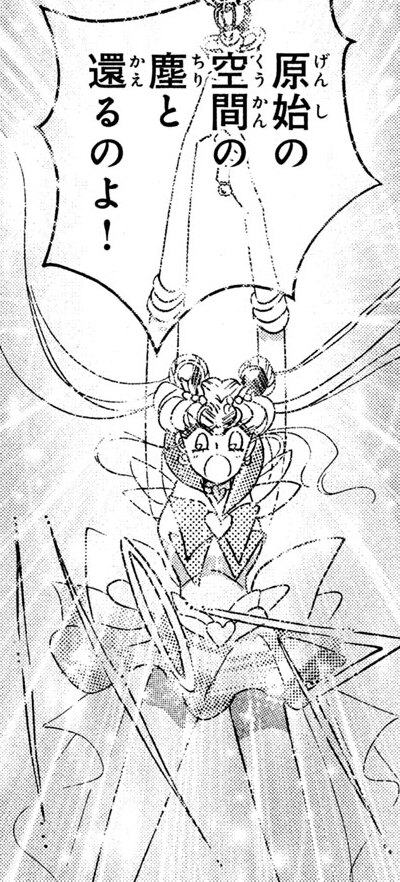
Princess Snow Kaguya’s comet is headed for Earth, and the Sailor Guardians fight her through a blizzard on Christmas Eve. When the clouds part and the full moon comes out, Kaguya flees into space. The guardians combine their power, Usagi transforms into Super Sailor Moon, and they chase Kaguya there. As Kaguya realizes they’ve followed her, Usagi calls her a twisted wanderer of ice.
- うさぎ:
- 「原始の空間の塵と還るのよ!」
- “Go back to being dust in primordial space!”
- Literal: “You will return as the dust of primordial space!”
Key Points
- The standard spelling of this かえる is 帰る, “go back”. The official kanji list gives 還 only its on reading カン, as in 生還, “coming back alive”, so 還る is an unofficial spelling.
- Manga use 還 for going back to where everything began, as in 土に還る, “return to the earth”. Usagi’s line works the same way, with the void of space as the place everything began.
- The usual pattern is に, which marks where something goes back to, as in 土に還る. Here the particle is と, and it marks what Kaguya will be when she returns.
- This と names the result of a change, as in 〜となる, “become”. 塵と還る is “return, turned to dust”. It sounds more formal than に, which suits a battle declaration.
- 原始 is “primeval” or “primitive”, and 空間 is “space”. 原始の空間 is space as it was at the very beginning, before anything formed.
- The two の stack up. 原始の describes the space, and 空間の describes the dust, giving “the dust of primordial space”.
- The dictionary form 還る plus のだ can work as a firm order. のよ is a softer, more feminine version, the way a mother says 早く寝るのよ, “go to bed now”.
- Here it carries no softness. Usagi is announcing Kaguya’s fate as something already decided.
Vocabulary
| Word | English | Meaning |
|---|---|---|
| 原始 | Primeval | 原始 describes the earliest state of something, before it developed, as in 原始時代, “primitive times”, or 原始的, “primitive”. |
| 空間 | Space | 空間 is the open room around and between things, with nothing filling it. |
| 塵 | Dust | 塵 is dust, the fine bits of dirt that settle on things or drift in the air. It also stands for something tiny or worthless, as in 塵も積もれば山となる, “even dust piles up into a mountain”. |
| 還る | To return (to the source) | 還る is an unofficial spelling of 帰る, “go back”. Manga use it for going back to where something began, as in 土に還る, “return to the earth”. |
See Also
- Vocabulary: Going home and giving back with かえる
- Grammar: Reasoning with 〜のだ
- Grammar: Informing with よ
- Kanji: Spaces and intervals with 間