Riding the current away fast with 速い
Vocabulary Explanation: Early and fast with はやい
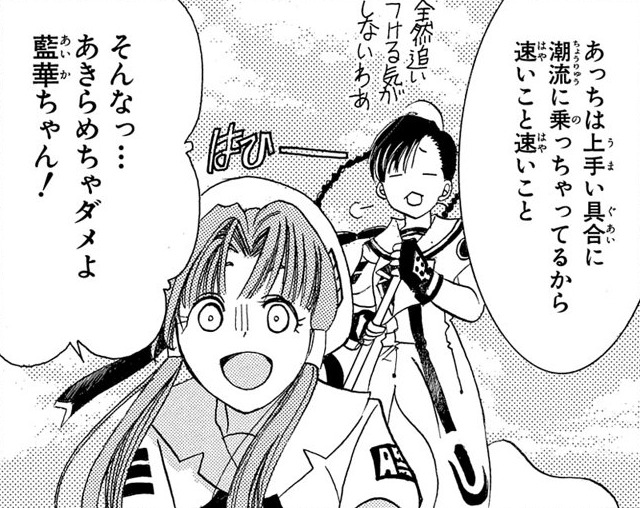
Aika, an apprentice gondolier from the rival company Himeya, has dropped by ARIA Company, where Akari works. President Aria, the company’s cat, starts drifting away alone in a gondola, and Akari jumps into Aika’s gondola and urges her to chase him. Aika rows after him, but at this time of day the tidal currents are tricky.
- 藍華:
- 「あっちは上手い具合に潮流に乗っちゃってるから速いこと速いこと」
- “That one's caught the current just right, so it's fast, really fast.”
- 「全然追いつける気がしないわぁ」
- “I don't feel like we'll ever catch up.”
- 灯里:
- 「そんなっ… あきらめちゃダメよ 藍華ちゃん!」
- “No way... You can't give up, Aika!”
Key Points
- 速い describes speed: how fast something moves. Here the current is carrying President Aria’s gondola away faster than Aika can row.
- The opposite would be 遅い, “slow”. This is the 速 of 流れが速い, “the current is fast”. 早い would be about time, as in something happening early.
- こと after an adjective can end a sentence as an exclamation, as in きれいなこと, “how pretty”. Saying it twice stresses it, like “boy, is it fast”.
- The pattern usually describes something the speaker is watching happen, here the gondola pulling away.
- 上手い具合に means “nicely” or “just right”. 上手い is read うまい here, not じょうず.
- 乗っちゃってる is 乗ってしまっている. ている shows the gondola is already riding the current, and ちゃう shows that this works against Aika.
- 追いつける is the potential form of 追いつく, “catch up”. 気がしない is “don’t feel like”, so the line is “I don’t feel like we can catch up at all”.
- ちゃダメ is the casual form of てはだめ, “you mustn’t”. Akari tells Aika not to give up.
Vocabulary
| Word | English | Meaning |
|---|---|---|
| あっち | Over there | あっち is a casual way to point to a place or thing away from both the speaker and the listener: “over there”, “that way”, or “that one”. The polite form is あちら. |
| 上手い | Skillful | 上手い is うまい written with the kanji of 上手. It describes something done well or working out nicely, as in 上手い具合に, “just right”. |
| 具合 | Condition | 具合 is the condition of something, such as your health or how a machine is running. It also means the way something goes, as in うまい具合に, “nicely” or “just right”. |
| 潮流 | Tide current | 潮流 is a current in the sea caused by the tides. It also means the main current of thought or fashion in an era. |
| 乗る | To ride | 乗る is to get on or ride a vehicle, an animal, or anything else that carries you. It also means being carried along by something, such as a current or the wind, or going along with a mood or an offer. |
| 速い | Fast | 速い describes something that moves or happens at high speed, such as a runner, a pitch, or a current. Its opposite is 遅い, “slow”. For something early in time, the same word is written 早い. |
| こと | Thing | こと is an abstract thing, matter, or fact, as opposed to a physical object. It also turns a verb phrase into a noun, as in 見たことがある. It is also written 事. |
| 全然 | Not at all | 全然 means not at all when used with a negative expression. In casual modern speech, it can also strengthen an affirmative statement to mean completely or entirely. |
| 追いつく | To catch up | 追いつく is to reach someone or something ahead of you by going faster than they do. It also means reaching the same level as others. |
| 気がする | To feel like | 気がする is to have a feeling or sense that something is so, as in 勝てる気がする, “I feel like we can win”. In the negative, it says the speaker can’t picture it happening. |
| そんな | Like that | そんな describes something like the thing just mentioned. Said alone, it shows shock or denial: “no way!” |
| あきらめる | To give up | あきらめる is to give up on a hope or plan and accept that it won’t happen. It is also written 諦める. |
| ダメ | No good | ダメ is a katakana spelling of だめ, describing something that is useless or not allowed. |
See Also
- Vocabulary: Early and fast with はやい
- Grammar: Doing completely or ending up doing with 〜てしまう and 〜ちゃう
- Grammar: Ongoing actions and resulting states with 〜ている
- Grammar: Because with 〜から
- Grammar: Thinking or feeling something with 〜気がする
- Grammar: Not at all with 全然〜ない
- Grammar: Able to do with 〜れる・〜られる
- Grammar: Must not do with 〜てはだめだ
- Kanji: Hands and skill with 手
- Kanji: Joining and fitting with 合
- Kanji: Wholeness and completion with 全