Roast it properly with ちゃんと
Vocabulary Explanation: Do it properly with ちゃんと
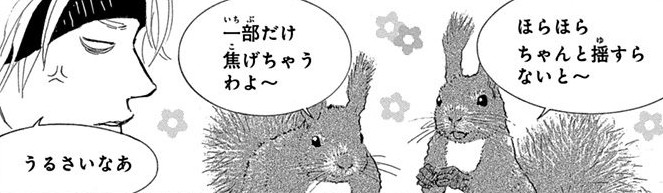
Masaki’s dream job making coffee turns out to be nothing like he expected, as he’s put to work sorting out good beans from bad. When he finally has the chance to roast beans, he’s eager to use the fancy roasting machine, but he’s instead given a handheld coffee roaster to hold over a portable stove’s flame.
- エゾリスA:
- 「ほらほら ちゃんと揺すらないと〜」
- “Come on, come on. You have to shake it properly.”
- エゾリスB:
- 「一部だけ焦げちゃうわよ〜」
- “Parts of it might get burnt.”
- マサキ:
- 「うるさいなあ」
- “Hush up!”
Key Points
- Here ちゃんと means Masaki needs to shake the roaster correctly and carefully, not just “somehow”.
- The point is that there is a proper technique for roasting evenly.
- 〜ないと gives a practical consequence: if he does not shake it, a problem will happen.
- In context, the missing result is supplied by the next line about beans burning.
- ほらほら pushes him along: “come on, come on”.
- 一部だけ 焦げちゃうわよ explains why the shaking matters: only part of the batch may burn.
- 焦げちゃう is a contraction of 焦げてしまう.
- It suggests an accidental or undesirable outcome: the beans could end up getting scorched.
Vocabulary
| Word | English | Meaning |
|---|---|---|
| ちゃんと | Properly | ちゃんと describes doing something correctly and with care, the way it should be done. |
| 揺する | To shake | 揺する is to shake or rock something back and forth. |
| 一部 | Part | 一部 is one part of a larger whole, or some members of a group. |
| 焦げる | To burn | 焦げる is for food or another thing to turn black or brown from too much heat. |
| うるさい | Noisy | うるさい describes something loud and noisy. It also describes someone or something bothersome or nagging. Said alone, it means “shut up!” |
See Also
- Vocabulary: Do it properly with ちゃんと
- Grammar: Doing completely or ending up doing with 〜てしまう and 〜ちゃう
- Grammar: Natural result with 〜と
- Grammar: Must do with 〜なければならない
- Grammar: Limiting with 〜だけ
- Kanji: Scorching and impatience with 焦
- Kanji: Sections and departments with 部