Scared of the fishhook with 釣り針
Kanji Explanation: Fishing and baiting with 釣
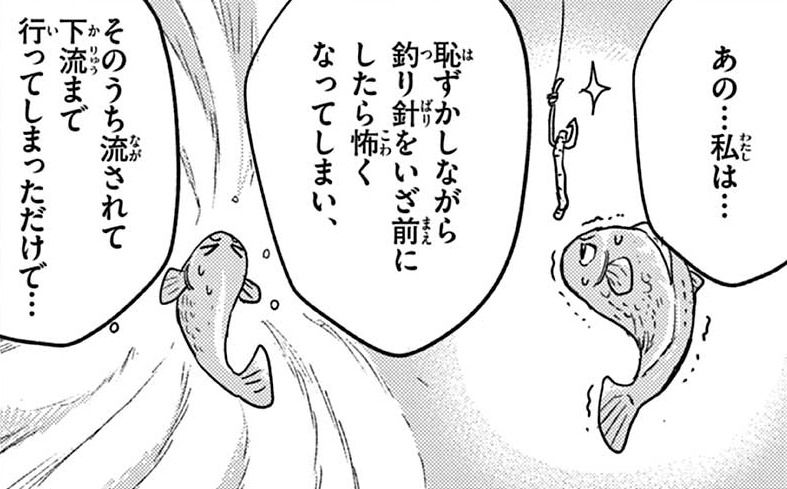
During a fishing contest, Rindou can’t catch a single fish and becomes so discouraged she offers to turn into a fish herself. Tsubaki goes off alone, promising to find a spot where Rindou will catch something, and soon Rindou hooks a huge fish. When Tsubaki returns soaking wet from downstream, Rindou thanks her for using her transformation technique to become the fish. Rindou says she enjoyed getting to catch a big fish.
- ツバキ:
- 「あの…私は…」
- “Um... I...”
- 「恥ずかしながら釣り針をいざ前にしたら怖くなってしまい、」
- “I'm embarrassed to say it, but when I was actually face to face with the hook, I got scared...”
- 「そのうち流されて下流まで行ってしまっただけで…」
- “...and then the current just carried me all the way downstream...”
Key Points
- 釣り針 is a fishhook. 針, “needle”, becomes ばり after 釣り, a sound change called rendaku.
- The flashback puts the hook right in front of Tsubaki’s fish form, sparkling, while she trembles.
- 恥ずかしながら means “embarrassing as it is”. This ながら means “although”, not “while doing”. Speakers use the phrase to introduce an embarrassing admission.
- 〜を前にする means to be face to face with something. いざ adds “when it actually came to it”, and たら marks the moment things changed.
- 怖くなってしまい joins 怖くなる, “to get scared”, with てしまう, which shows she regrets it. The stem しまい links to the next clause in a formal, written style.
- 流される is the passive of 流す: the current swept her along. 下流まで is “all the way downstream”.
- だけで means “that’s all that happened”. She’s admitting she didn’t do the clever thing Rindou thinks she did.
Vocabulary
| Word | English | Meaning |
|---|---|---|
| 私 | I | 私 means “I” or “me”. It is the standard first-person pronoun in polite speech and is also common in casual speech among women. |
| 恥ずかしながら | Embarrassing as it is | 恥ずかしながら opens an admission the speaker finds embarrassing, like “I’m ashamed to say”. |
| 釣り針 | Fishhook | 釣り針 is a fishhook, the small curved hook that holds the bait and catches the fish. |
| いざ | Actually, for real | いざ marks the moment something stops being a plan and has to be done for real, as in いざ買うとなると, “when it actually comes to buying”. On its own, it’s an old-fashioned “Now then!” said before starting something. |
| 前 | Front | 前 is the front of something. It also means an earlier time, as in 三年前, “three years ago”. |
| する | To do | する is to do or perform something. It also turns many nouns into verbs, as in 勉強する. |
| 怖い | Scary | 怖い describes something that makes you afraid. |
| なる | To become | なる is to change into a different state or become something. It also means something turns out a certain way. It is also written 成る. |
| そのうち | Before long | そのうち says that something will happen after a while, without saying exactly when. |
| 流す | To play | 流す is to let something flow. It also means to play music or broadcast something. |
| 下流 | Downstream | 下流 is the part of a river toward its mouth, the direction the water flows. |
| 行く | To go | 行く means to go or move toward a place away from the speaker. |
| だけ | Only | だけ limits something to what it follows and excludes anything else: これだけ, “just this”. |
See Also
- Kanji: Fishing and baiting with 釣
- Grammar: When the time comes with いざ〜となると
- Grammar: If and when with 〜たら
- Grammar: Doing completely or ending up doing with 〜てしまう and 〜ちゃう
- Grammar: Receptive verbs with 〜れる
- Grammar: Limiting with 〜だけ
- Kanji: Below and lowering with 下
- Kanji: Going and carrying out with 行
- Kanji: Privacy and self with 私