Scheduled to stay the night with 〜ことになっている
Grammar Explanation: Past decision still in effect with 〜ことになっている
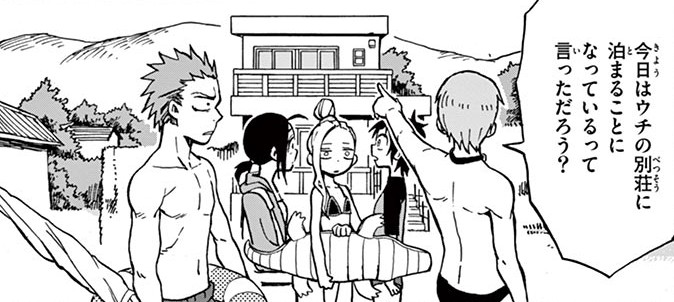
After a day playing at the beach, Hikari asks Shindou when someone is coming to pick everyone up. Shindou says it will be “tomorrow evening”.
- 神藤:
- 「今日はウチの別荘に泊まることになっているって言っただろう?」
- “Didn't I say we're scheduled to stay the night at my villa?”
- Literal: “I said that today it has become the thing that we're staying at my villa, right?”
Key Points
- The group is scheduled to stay at Shindou’s villa tonight.
- The pattern points to an existing plan, not a decision being made in this moment.
- Shindou says he already told them this.
- だろう expects Hikari to recognize or remember the information.
- 今日は limits the arrangement to tonight.
- Tomorrow evening pickup only makes sense because tonight has already been decided.
Vocabulary
| Word | English | Meaning |
|---|---|---|
| 今日 | Today | 今日 means today. In formal writing, it can also mean the present day or current era. |
| ウチ | My home | ウチ is a katakana spelling of うち, “my home”, “my family”, or “our side”. |
| 別荘 | Villa | 別荘 is a second home, such as a vacation house in the mountains or by the sea. |
| 泊まる | To stay overnight | 泊まる is to stay the night somewhere away from home. |
| こと | Thing | こと is an abstract thing, matter, or fact, as opposed to a physical object. It also turns a verb phrase into a noun, as in 見たことがある. It is also written 事. |
| なる | To become | なる is to change into a different state or become something. It also means something turns out a certain way. It is also written 成る. |
| 言う | To say | 言う means to say or tell. It can also mean to call something by a particular name. |
See Also
- Grammar: Past decision still in effect with 〜ことになっている
- Grammar: Past tense with 〜た・〜だ
- Grammar: Presuming with 〜だろう and 〜でしょう
- Grammar: Marking the topic with は and も
- Grammar: Quoting and reporting with と and って
- Grammar: How casual contractions work
- Kanji: Now and the present with 今